Label examples / Reed diffuser and room spray label examples
Reed diffuser and room spray label examples
Published 27 September 2026; rules last checked 25 September 2026. A labelling reference, not legal advice.
Three labels built in the home-fragrance tool: a reed diffuser for the EU, the same diffuser for Great Britain, and a pump room spray. Each starts from a classification entered the way a supplier's CLP data would give it, made up here for illustration. Building and previewing a label is free; you pay only to export it.
A diffuser or spray is labelled under the same rules as a candle, but its liquid base often brings classes a candle does not, such as flammability. The examples show two pictograms on one label and a single signal word.
Reed diffuser
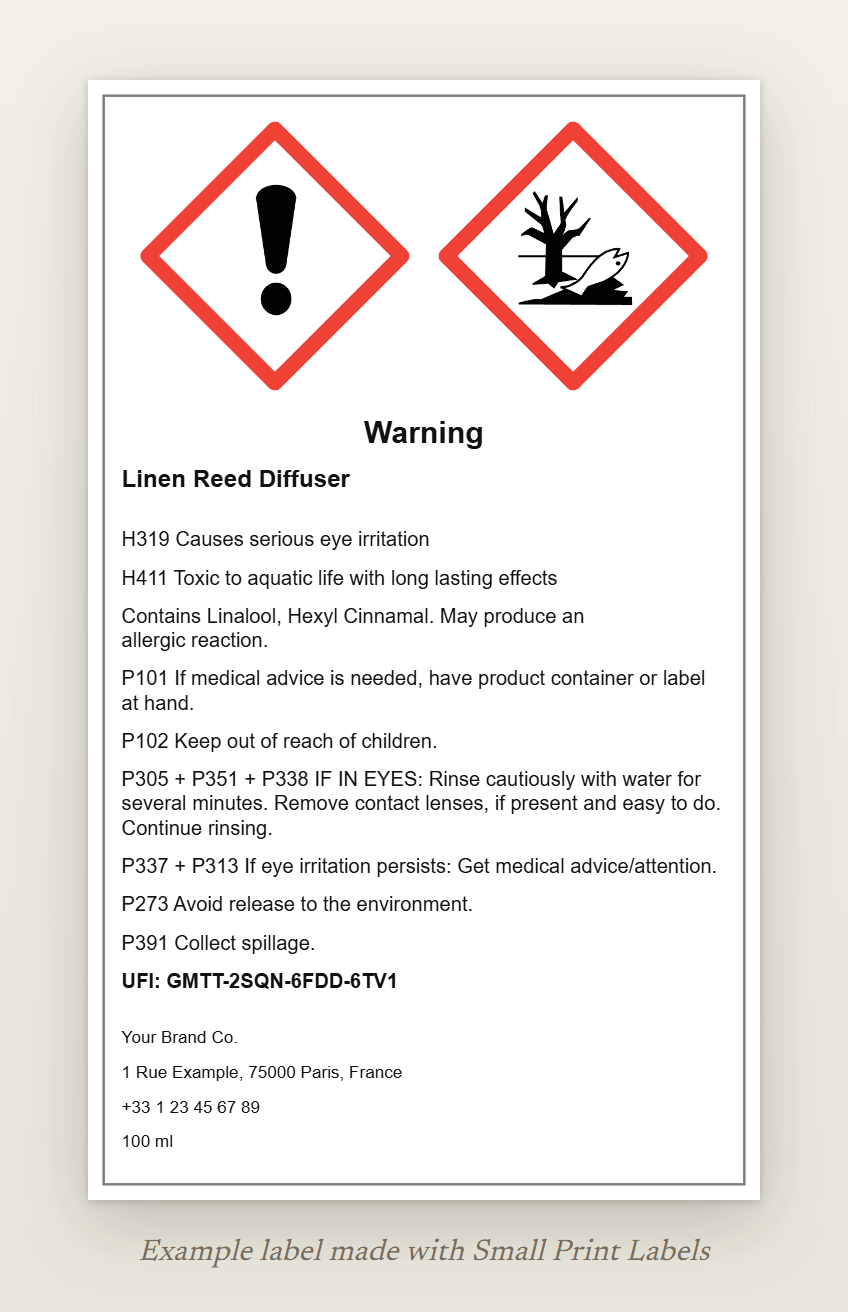
Two pictograms side by side, one signal word: Warning. Six precautionary statements is the most Article 28(3) expects on a label, unless more are needed for the nature and severity of the hazards. The UFI shown is the worked example from ECHA's UFI developers manual.
What went into the home-fragrance tool
- Region
- European Union
- Classification (from the supplier's data)
- Eye irritation, Category 2; Hazardous to the aquatic environment, Chronic 2
- Sensitisers to name
- Linalool, Hexyl Cinnamal
- Precautionary statements chosen
- 6, from the supplier's data
- UFI
- GMTT-2SQN-6FDD-6TV1 (the worked example from ECHA's UFI developers manual)
What the tool put on the label
- Pictograms: GHS07 (exclamation mark), GHS09 (environment)
- Signal word: Warning
- Product identifier: Linen Reed Diffuser
- Hazard statements: H319 Causes serious eye irritation; H411 Toxic to aquatic life with long lasting effects
- EUH208: Contains Linalool, Hexyl Cinnamal. May produce an allergic reaction.
- Precautionary statements:
- P101 If medical advice is needed, have product container or label at hand.
- P102 Keep out of reach of children.
- P305 + P351 + P338 IF IN EYES: Rinse cautiously with water for several minutes. Remove contact lenses, if present and easy to do. Continue rinsing.
- P337 + P313 If eye irritation persists: Get medical advice/attention.
- P273 Avoid release to the environment.
- P391 Collect spillage.
- UFI: GMTT-2SQN-6FDD-6TV1
- Supplier: Your Brand Co., 1 Rue Example, 75000 Paris, France, +33 1 23 45 67 89
- Nominal quantity: 100 ml
The same diffuser for Great Britain
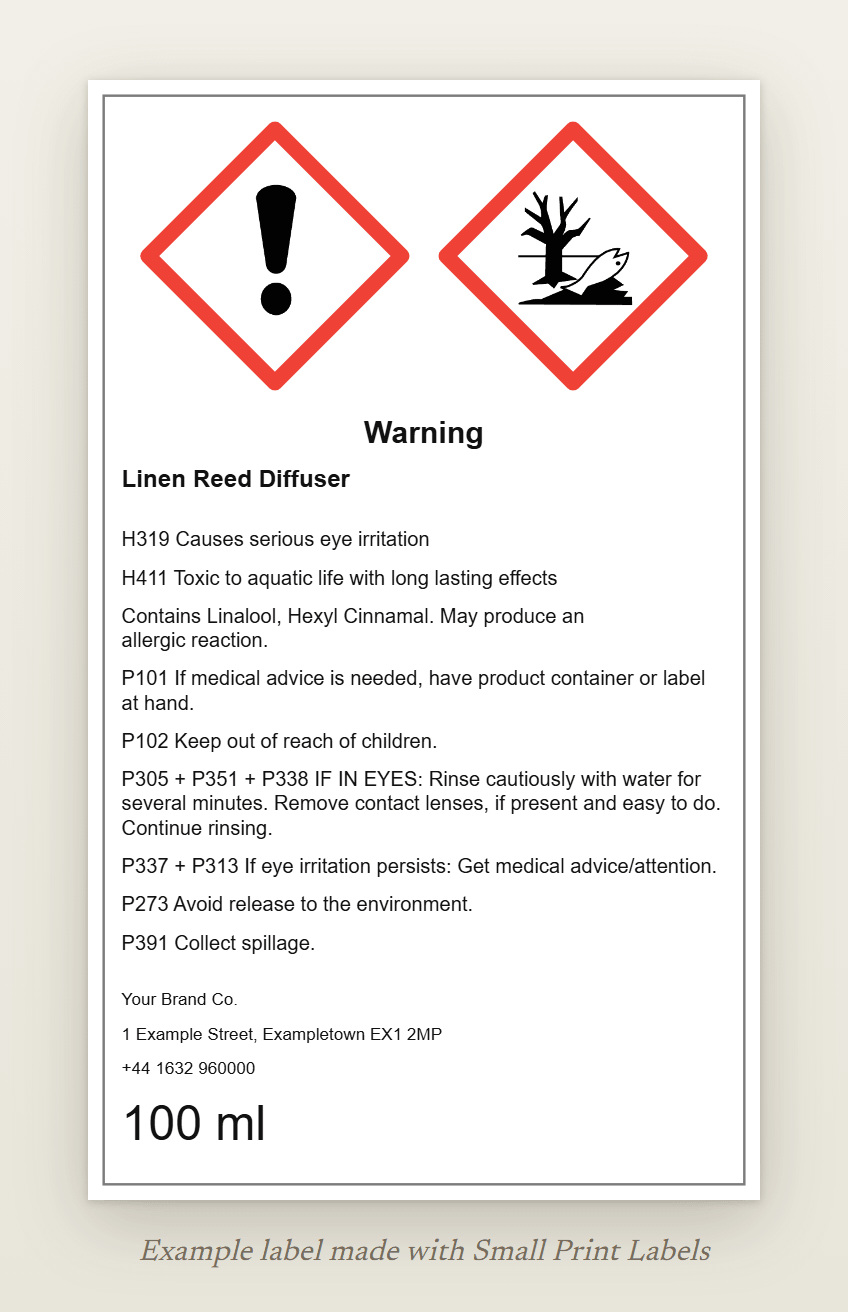
The same classification gives the same pictograms, signal word and statements under GB CLP. Two things differ: the supplier is the one placing it on the GB market, and there is no UFI, because GB CLP has no UFI duty since 31 December 2023.
What went into the home-fragrance tool
- Region
- Great Britain (UK)
- Classification (from the supplier's data)
- Eye irritation, Category 2; Hazardous to the aquatic environment, Chronic 2
- Sensitisers to name
- Linalool, Hexyl Cinnamal
- Precautionary statements chosen
- 6, from the supplier's data
What the tool put on the label
- Pictograms: GHS07 (exclamation mark), GHS09 (environment)
- Signal word: Warning
- Product identifier: Linen Reed Diffuser
- Hazard statements: H319 Causes serious eye irritation; H411 Toxic to aquatic life with long lasting effects
- EUH208: Contains Linalool, Hexyl Cinnamal. May produce an allergic reaction.
- Precautionary statements:
- P101 If medical advice is needed, have product container or label at hand.
- P102 Keep out of reach of children.
- P305 + P351 + P338 IF IN EYES: Rinse cautiously with water for several minutes. Remove contact lenses, if present and easy to do. Continue rinsing.
- P337 + P313 If eye irritation persists: Get medical advice/attention.
- P273 Avoid release to the environment.
- P391 Collect spillage.
- UFI: none; Great Britain has no UFI duty
- Supplier: Your Brand Co., 1 Example Street, Exampletown EX1 2MP, +44 1632 960000
- Nominal quantity: 100 ml
Room spray (pump)
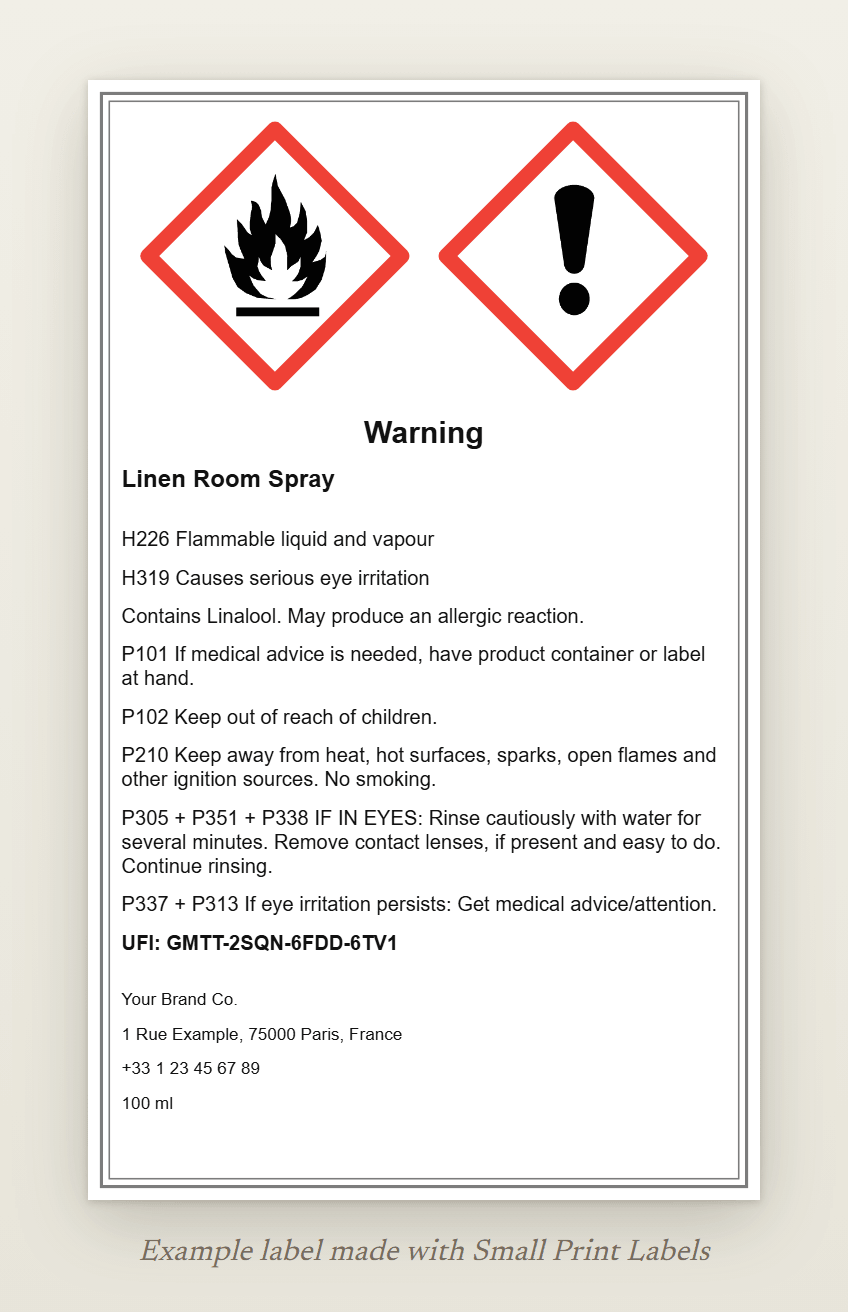
A spray with enough alcohol to classify as a Category 3 flammable liquid carries the flame pictogram (GHS02) and H226, and P210 keeps it away from heat and flames. Category 3 does not need the tactile warning or the child-resistant closure that some other classes bring. This is a pump spray; a pressurised aerosol is classified under a different class.
What went into the home-fragrance tool
- Region
- European Union
- Classification (from the supplier's data)
- Flammable liquid, Category 3; Eye irritation, Category 2
- Sensitisers to name
- Linalool
- Precautionary statements chosen
- 5, from the supplier's data
- UFI
- GMTT-2SQN-6FDD-6TV1 (the worked example from ECHA's UFI developers manual)
What the tool put on the label
- Pictograms: GHS02 (flame), GHS07 (exclamation mark)
- Signal word: Warning
- Product identifier: Linen Room Spray
- Hazard statements: H226 Flammable liquid and vapour; H319 Causes serious eye irritation
- EUH208: Contains Linalool. May produce an allergic reaction.
- Precautionary statements:
- P101 If medical advice is needed, have product container or label at hand.
- P102 Keep out of reach of children.
- P210 Keep away from heat, hot surfaces, sparks, open flames and other ignition sources. No smoking.
- P305 + P351 + P338 IF IN EYES: Rinse cautiously with water for several minutes. Remove contact lenses, if present and easy to do. Continue rinsing.
- P337 + P313 If eye irritation persists: Get medical advice/attention.
- UFI: GMTT-2SQN-6FDD-6TV1
- Supplier: Your Brand Co., 1 Rue Example, 75000 Paris, France, +33 1 23 45 67 89
- Nominal quantity: 100 ml
If your diffuser is classified as an aspiration hazard
A diffuser classified Aspiration Hazard 1 (H304) carries the GHS08 health hazard pictogram and the signal word Danger, and the substances responsible are named as part of the product identifier (Article 18(3)(b)). Supplied to the general public, it also needs a child-resistant fastening (Annex II, 3.1.1.2, which excepts aerosols and containers with a sealed spray attachment) and a tactile warning of danger (Annex II, 3.2.1.1).
Size, statements and the rest
- For a package of up to 3 litres, Table 1.3 of Annex I asks for a label of at least 52 × 74 mm where possible and each pictogram at least 10 × 10 mm; the examples use 60 × 100 mm bottle labels.
- Precautionary statements come from the supplier's document, six at most unless more are needed for the nature and severity of the hazards (Article 28(3)). Where Annex I lists P501, as it does for the aquatic classes, the supplier completes its wording ("Dispose of contents/container to ...").
- A flammable liquid of category 1 or 2 supplied to the general public needs a tactile warning of danger on its packaging (Annex II, 3.2.1.1); category 3, as in the room spray example, does not.
- From 1 January 2028, a label placed on the EU market or in Northern Ireland must also be printed in black on white in a single sans-serif font, with a minimum x-height and line spacing (Regulation (EU) 2024/2865, date set by Regulation (EU) 2025/2439). Great Britain has adopted none of this. The examples follow today's rules.
The reed diffuser and room spray page covers the classes a liquid base brings, and the CLP hazard statement pages give every statement and pictogram the tools use.
Selling in the United States? The label there follows the Federal Hazardous Substances Act instead: see the US reed diffuser and room spray examples.
Questions makers ask
Does a room spray need a CLP label?
Yes, when it is classified as hazardous or needs the EUH208 line: a pump spray is a mixture like a candle or a diffuser. A pressurised aerosol is classified in its own class (Annex I, section 2.3), not as a flammable liquid.
What changes between the EU and the UK diffuser labels?
The classification gives the same pictograms, signal word and statements under both texts. In the EU and Northern Ireland a mixture classified for a health or physical hazard also carries a UFI; Great Britain has had no UFI duty since 31 December 2023. The supplier on each label is the one placing the diffuser on that market.
Can I copy these labels for my diffuser?
No. The label follows from your product's classification, which your supplier's CLP data gives for your fragrance and base at your load. A different base or load can change it. Tick your supplier's classification in the home-fragrance tool and it assembles the label from it.
Read before you print
- UK candle CLP labels: what has to be on them
- EU candle CLP labels: what has to be on them
- US reed diffuser and room spray label requirements
- Do I need a UFI to sell candles in the UK?
- Do I need a UFI to sell candles in the EU?
- Does my home address have to be on a candle label?
- Does changing the fragrance load change the CLP label?
- CLP labels for a custom blend of fragrance oils
- Can I rename the fragrance on a CLP label?
- Do you need a barcode to sell handmade products?
- Reed diffuser and room spray labels: what CLP asks for
- Do candles at craft fairs or as gifts need a CLP label?
More label examples
Sources
- Regulation (EC) No 1272/2008 (CLP), consolidated 01.07.2026, CELEX 02008R1272: Articles 17, 18(3)(b), 28(3) and 31(1); Annex I, Table 1.3, Table 2.6.1 and its note on aerosols, Table 4.1.4; Annex II, sections 2.8, 3.1.1.2 and 3.2.1.1; Annex IV (precautionary statement wording); Annex V (pictograms); Annex VIII (UFI)
- Regulation (EU) 2024/2865 (the CLP revision) and Regulation (EU) 2025/2439, which moved its label format rules to 1 January 2028
- Regulation (EC) No 1272/2008 as it applies in Great Britain (GB CLP), legislation.gov.uk, text current to 21 May 2026: Article 17(2) (English) and the omitted Article 25(7) (UFI)
- ECHA, UFI Developers Manual, version 1.5 (January 2022): the worked example UFI
The same documents our rule tables are transcribed from and checked against. The recipes, brand names and supplier figures in the examples are made up for illustration. A labelling reference, not legal advice; you remain responsible for your product's labelling.