Label examples / Natasha's Law label examples
Natasha's Law label examples
Published 27 September 2026; rules last checked 25 September 2026. A labelling reference, not legal advice.
Four labels for food prepacked for direct sale, each made in the food tool from the ingredients shown under it. Across the UK, such food must show two things on its packaging or a label attached to it: the name of the food, and the full ingredient list with each of the 14 allergens emphasised. Both duties have applied since 1 October 2021. Seeing the list is free; you pay only to export the finished label.
Each example shows the part that trips people up: an allergen hidden in a compound ingredient, an ingredient whose name does not name its allergen, and cereals containing gluten named by the cereal itself.
Victoria sponge
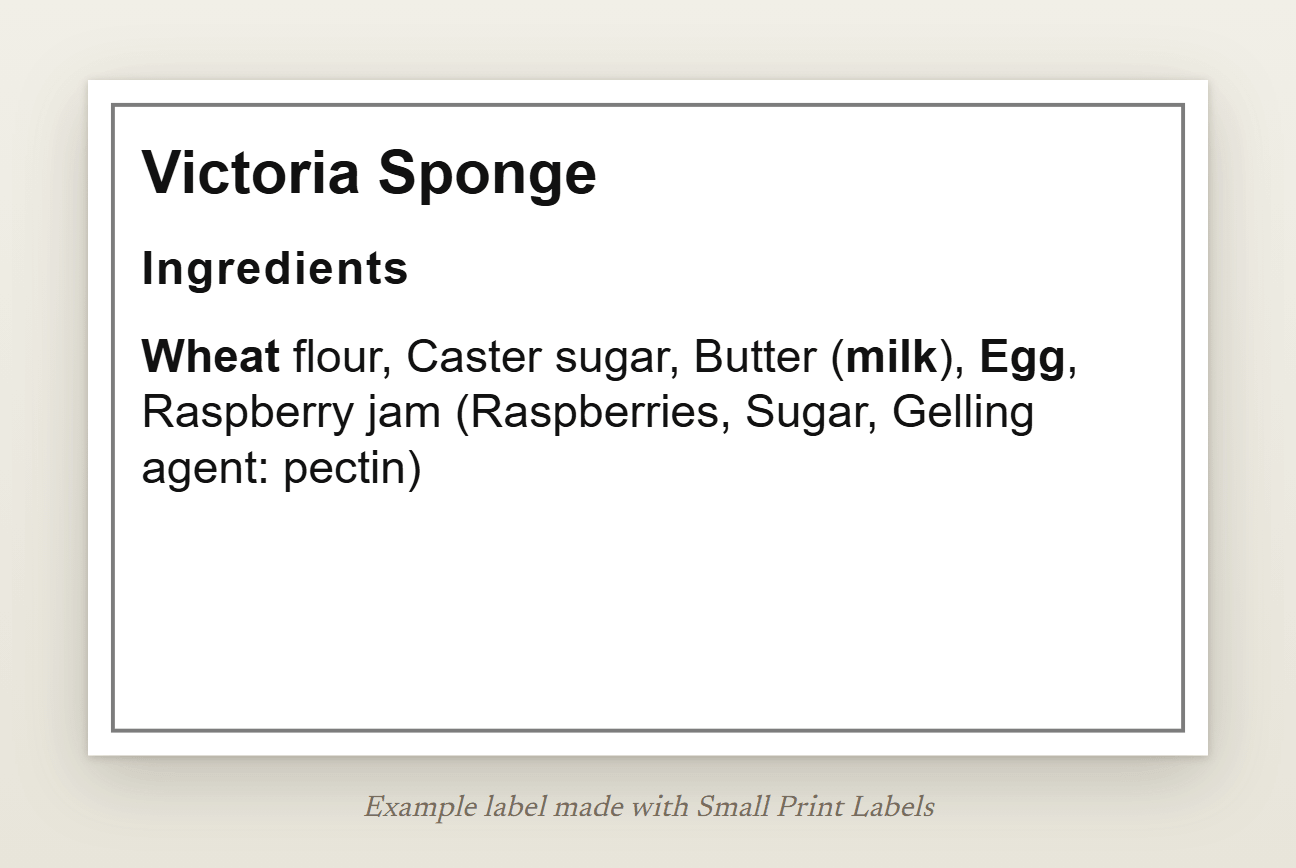
The two things Natasha's Law asks for: the name of the food, and the full ingredient list in descending weight with each of the 14 allergens emphasised. Butter carries "(milk)" because its own name does not name the allergen; the jam, a compound ingredient, lists its own ingredients in brackets.
The ingredients, as entered in the food tool
| Ingredient | Grams | Allergen ticked |
|---|---|---|
| Wheat flour | 250 | Cereals containing gluten |
| Caster sugar | 200 | |
| Butter | 200 | Milk (incl. lactose) |
| Egg | 200 | Eggs |
| Raspberry jam | 100 | |
| Raspberries | 55 | |
| Sugar | 44 | |
| Gelling agent: pectin | 1 |
The label text it printed
Victoria Sponge
Ingredients: Wheat flour, Caster sugar, Butter (milk), Egg, Raspberry jam (Raspberries, Sugar, Gelling agent: pectin)
Chocolate walnut brownie
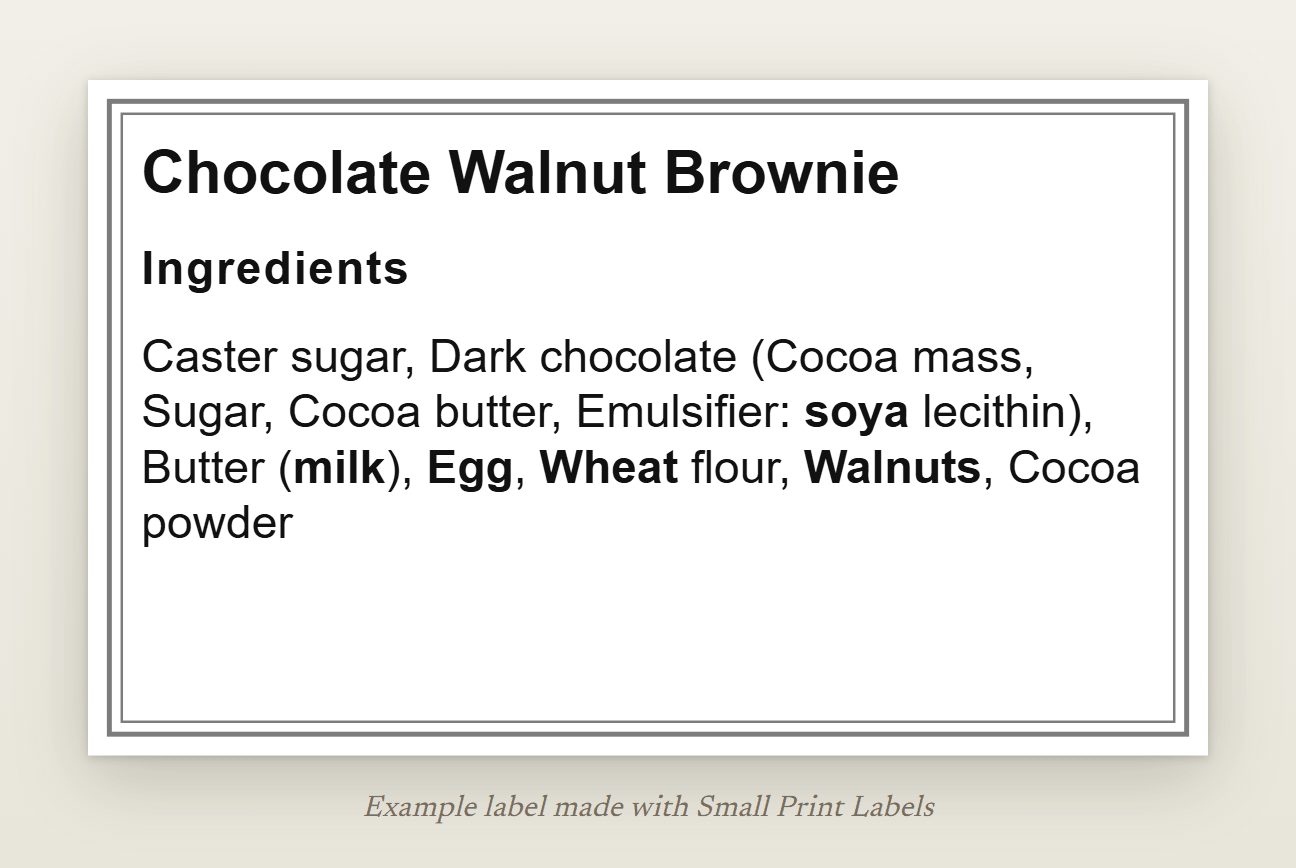
Five allergens, each emphasised where it appears: soya inside the chocolate's own ingredient list, milk after butter, egg, wheat and walnuts. The list runs by weight, so caster sugar leads.
The ingredients, as entered in the food tool
| Ingredient | Grams | Allergen ticked |
|---|---|---|
| Dark chocolate | 200 | |
| Cocoa mass | 110 | |
| Sugar | 80 | |
| Cocoa butter | 8 | |
| Emulsifier: soya lecithin | 2 | Soybeans |
| Butter | 180 | Milk (incl. lactose) |
| Caster sugar | 250 | |
| Egg | 150 | Eggs |
| Wheat flour | 90 | Cereals containing gluten |
| Walnuts | 80 | Nuts (tree nuts) |
| Cocoa powder | 30 |
The label text it printed
Chocolate Walnut Brownie
Ingredients: Caster sugar, Dark chocolate (Cocoa mass, Sugar, Cocoa butter, Emulsifier: soya lecithin), Butter (milk), Egg, Wheat flour, Walnuts, Cocoa powder
Oat flapjack
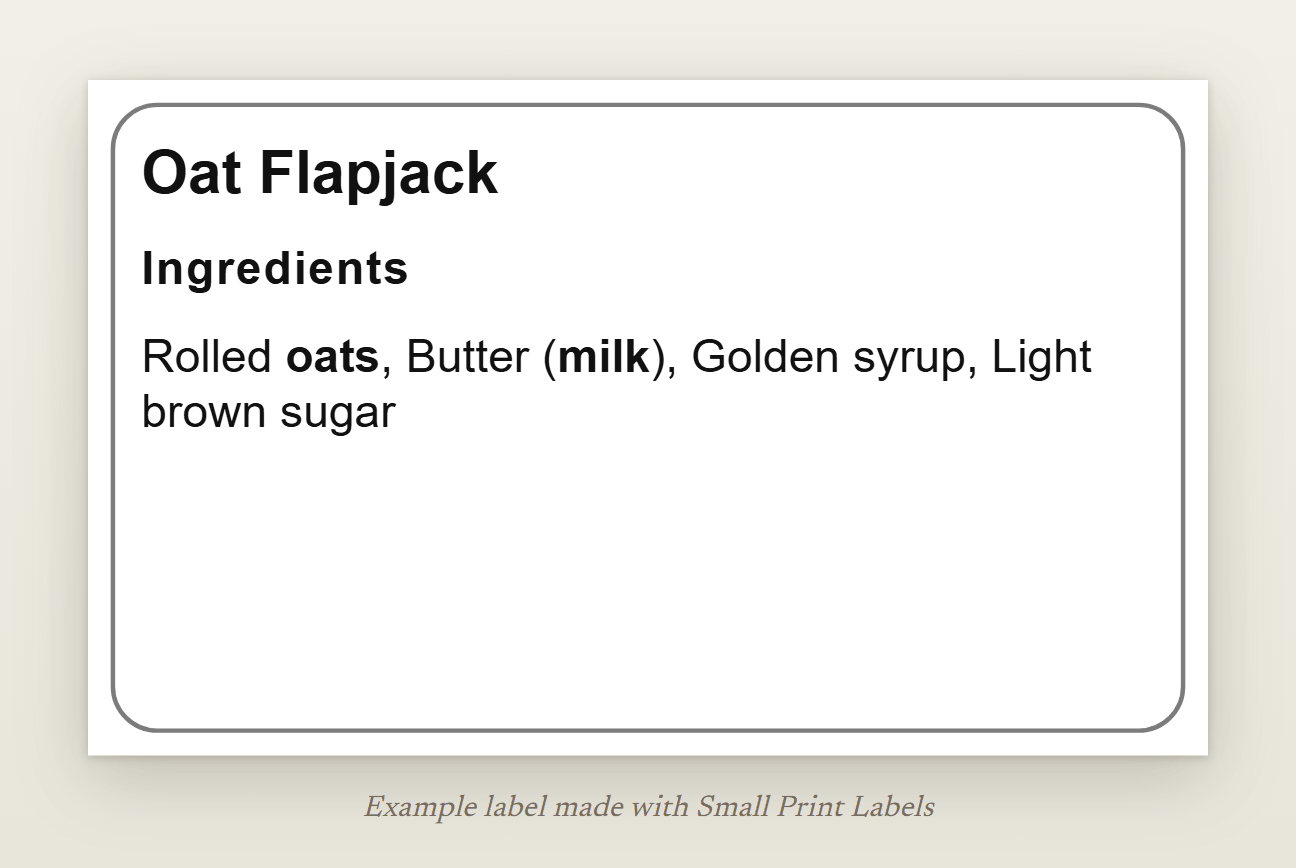
Oats are one of the cereals containing gluten that Annex II names, so the word oats is emphasised, not a separate "gluten" line.
The ingredients, as entered in the food tool
| Ingredient | Grams | Allergen ticked |
|---|---|---|
| Rolled oats | 250 | Cereals containing gluten |
| Butter | 125 | Milk (incl. lactose) |
| Golden syrup | 100 | |
| Light brown sugar | 75 |
The label text it printed
Oat Flapjack
Ingredients: Rolled oats, Butter (milk), Golden syrup, Light brown sugar
Egg and cress sandwich
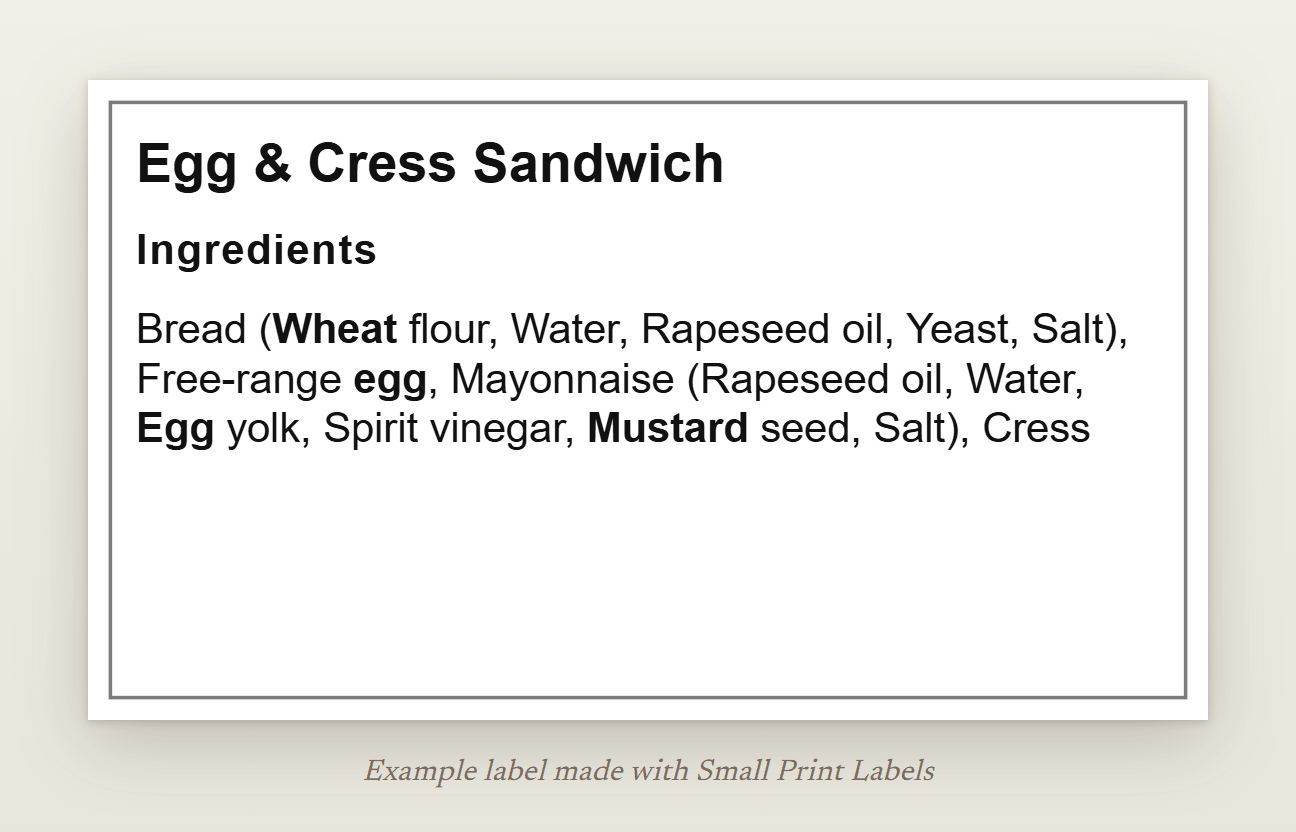
Two compound ingredients, the bread and the mayonnaise, each list their own ingredients, and the allergens are emphasised inside them: wheat in the bread, egg and mustard in the mayonnaise.
The ingredients, as entered in the food tool
| Ingredient | Grams | Allergen ticked |
|---|---|---|
| Bread | 90 | |
| Wheat flour | 55 | Cereals containing gluten |
| Water | 31 | |
| Rapeseed oil | 2 | |
| Yeast | 1 | |
| Salt | 1 | |
| Free-range egg | 50 | Eggs |
| Mayonnaise | 20 | |
| Rapeseed oil | 15 | |
| Water | 2 | |
| Egg yolk | 1.5 | Eggs |
| Spirit vinegar | 1 | |
| Mustard seed | 0.3 | Mustard |
| Salt | 0.2 | |
| Cress | 3 |
The label text it printed
Egg & Cress Sandwich
Ingredients: Bread (Wheat flour, Water, Rapeseed oil, Yeast, Salt), Free-range egg, Mayonnaise (Rapeseed oil, Water, Egg yolk, Spirit vinegar, Mustard seed, Salt), Cress
What a PPDS label does not have to show
Article 44(1) of the food information regulation makes the allergen particulars mandatory for food prepacked for direct sale and leaves the rest of Article 9, such as a date mark, a nutrition declaration or the net quantity, non-mandatory unless other UK regulations require them. The Natasha's Law regulations add the name and the ingredient list, and nothing more. The examples show exactly those two.
The mandatory particulars must be legible: an x-height of at least 1.2 mm, or 0.9 mm where the largest surface of the pack is under 80 cm² (Article 13(2) and (3)). The examples are set at an x-height above 1.2 mm.
The Natasha's Law guide covers small packs and the rules in each UK nation, and allergen emphasis on a home bakery label covers loose food and orders.
Questions makers ask
Can I download these Natasha's Law label templates?
These pictures are examples, made from the ingredients on this page, so they are not files to print. The food tool builds yours: add your ingredients and their weights, tick the allergens, and it orders the list and emphasises each allergen. Building and previewing the label is free; the print-ready PDF, PNG or SVG download is the paid step.
Why is "(milk)" in brackets after butter?
Article 21(1) needs each allergen's Annex II name in the list, emphasised. Butter's own name does not say milk, so the tool adds "(milk)" after it and emphasises that; an ingredient whose name already names the allergen, such as wheat flour, has the word emphasised where it stands.
Is a separate "Contains: milk, eggs" line enough?
No. Where there is an ingredient list, Article 21(1) puts the emphasis inside it, on each allergen's Annex II name. A "contains" statement replaces the emphasis only where there is no list, for example on a pack whose largest surface is under 10 cm².
Does food I sell online need a Natasha's Law label?
Not in the same way. The ingredient-list duty applies only to food offered for sale otherwise than by means of distance communication, and the name need not be on the pack for such sales, so orders taken by phone, message or website follow other rules.
Read before you print
More label examples
Sources
- The Food Information Regulations 2014 (SI 2014/1855), regulations 5A and 6A as inserted by the Food Information (Amendment) (England) Regulations 2019 (SI 2019/1218), in force 1 October 2021; the Welsh (SI 2020/295), Scottish (SSI 2021/70) and Northern Irish (SR 2020/80) regulations to the same effect
- Regulation (EU) No 1169/2011 as it applies in Great Britain (assimilated law): Articles 9(1), 13(2) and (3), 18, 21(1) and 44(1); Annex II (the 14 allergens); Annex VII, Part E (compound ingredients)
The same documents our rule tables are transcribed from and checked against. The recipes, brand names and supplier figures in the examples are made up for illustration. A labelling reference, not legal advice; you remain responsible for your product's labelling.