Label examples / Cosmetic label examples
Cosmetic label examples
Published 27 September 2026; rules last checked 25 September 2026. A labelling reference, not legal advice.
Four skincare labels, each made in the skincare tool from the recipe printed under it: a body butter and a lip balm on round lid stickers, a lotion and a beard oil. The ingredient lists are the tool's own output on the current EU rules, heaviest ingredient first, with the fragrance allergens named. Seeing and copying the list is free; you pay only to export the finished label.
A leave-on product names each fragrance allergen over 0.001 %, a limit ten times lower than soap's, so even a little fragrance puts its allergens on the label. Any ingredient can be typed with its supplier's INCI name after inci: and the tool prints it as entered; the examples do that for an emulsifier and a preservative booster the tool does not know by name (glyceryl stearate citrate, ethylhexylglycerin) and for vitamin E, a name that can mean more than one ingredient.
Body butter jar lid
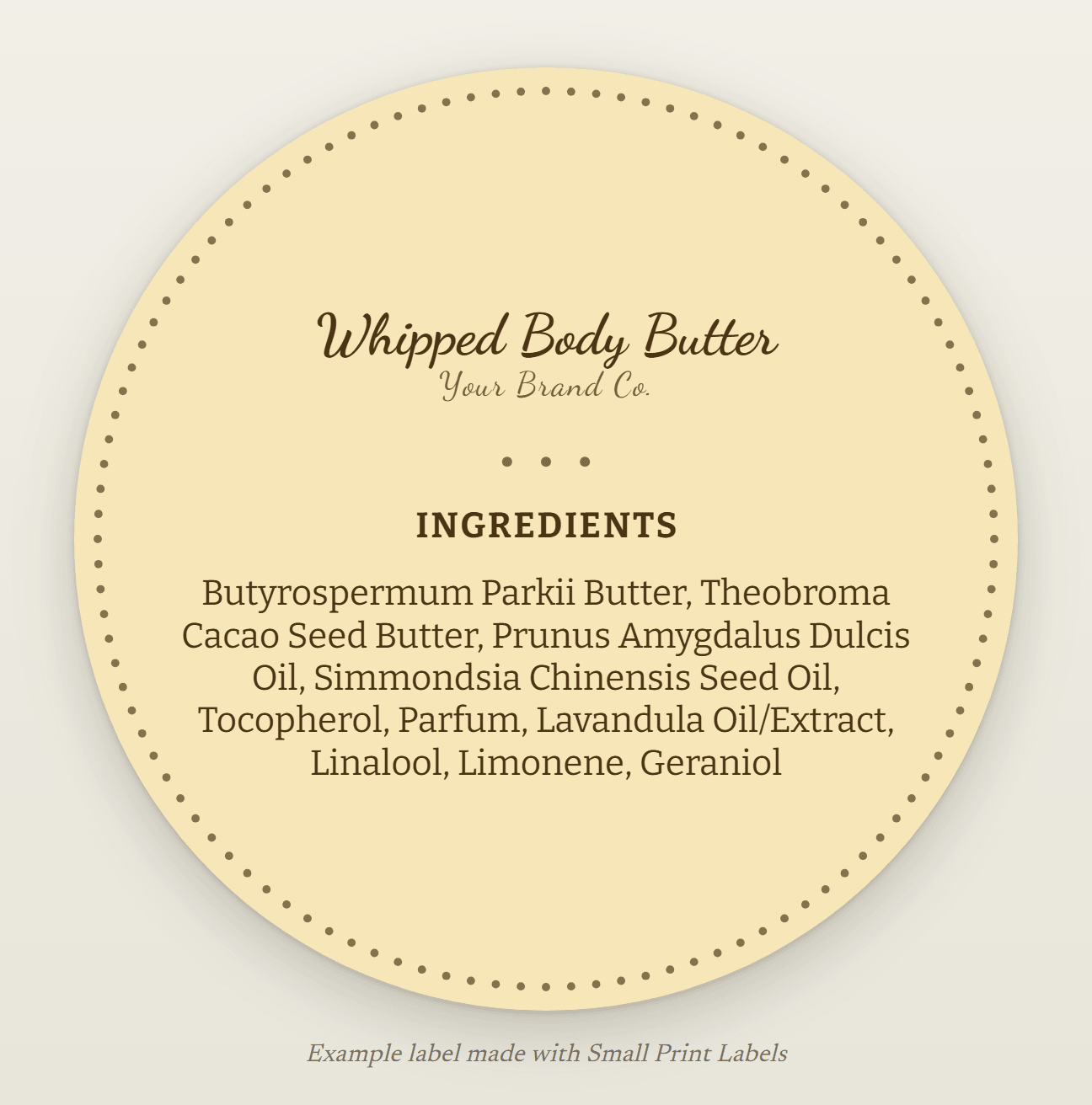
A body butter stays on the skin, so the allergen limit is ten times lower than for soap: 0.001 %. The butters and oils keep their plant names, because no lye saponifies them. Vitamin E is typed with its supplier's INCI name, Tocopherol, after inci: in the recipe.
The recipe, as typed into the skincare tool
Shea butter, 50
Cocoa butter, 20
Sweet almond oil, 20
Jojoba oil, 8
Vitamin E, 1, inci: Tocopherol
Lavender essential oil, 1 | Linalool 38, Limonene 1, Geraniol 1
Region: European Union. Product type: leave-on.
The ingredient list it printed
Butyrospermum Parkii Butter, Theobroma Cacao Seed Butter, Prunus Amygdalus Dulcis Oil, Simmondsia Chinensis Seed Oil, Tocopherol, Parfum, Lavandula Oil/Extract, Linalool, Limonene, Geraniol
| Name on the label | % of product | Type |
|---|---|---|
| Butyrospermum Parkii Butter | 50.00 | oil / butter |
| Theobroma Cacao Seed Butter | 20.00 | oil / butter |
| Prunus Amygdalus Dulcis Oil | 20.00 | oil / butter |
| Simmondsia Chinensis Seed Oil | 8.00 | oil / butter |
| Tocopherol | 1.00 | other |
| Parfum | 1.00 | fragrance |
| Lavandula Oil/Extract | 1.00 | allergen, over the 0.001 % limit |
| Linalool | 0.38 | allergen, over the 0.001 % limit |
| Limonene | 0.01 | allergen, over the 0.001 % limit |
| Geraniol | 0.01 | allergen, over the 0.001 % limit |
Lip balm tin
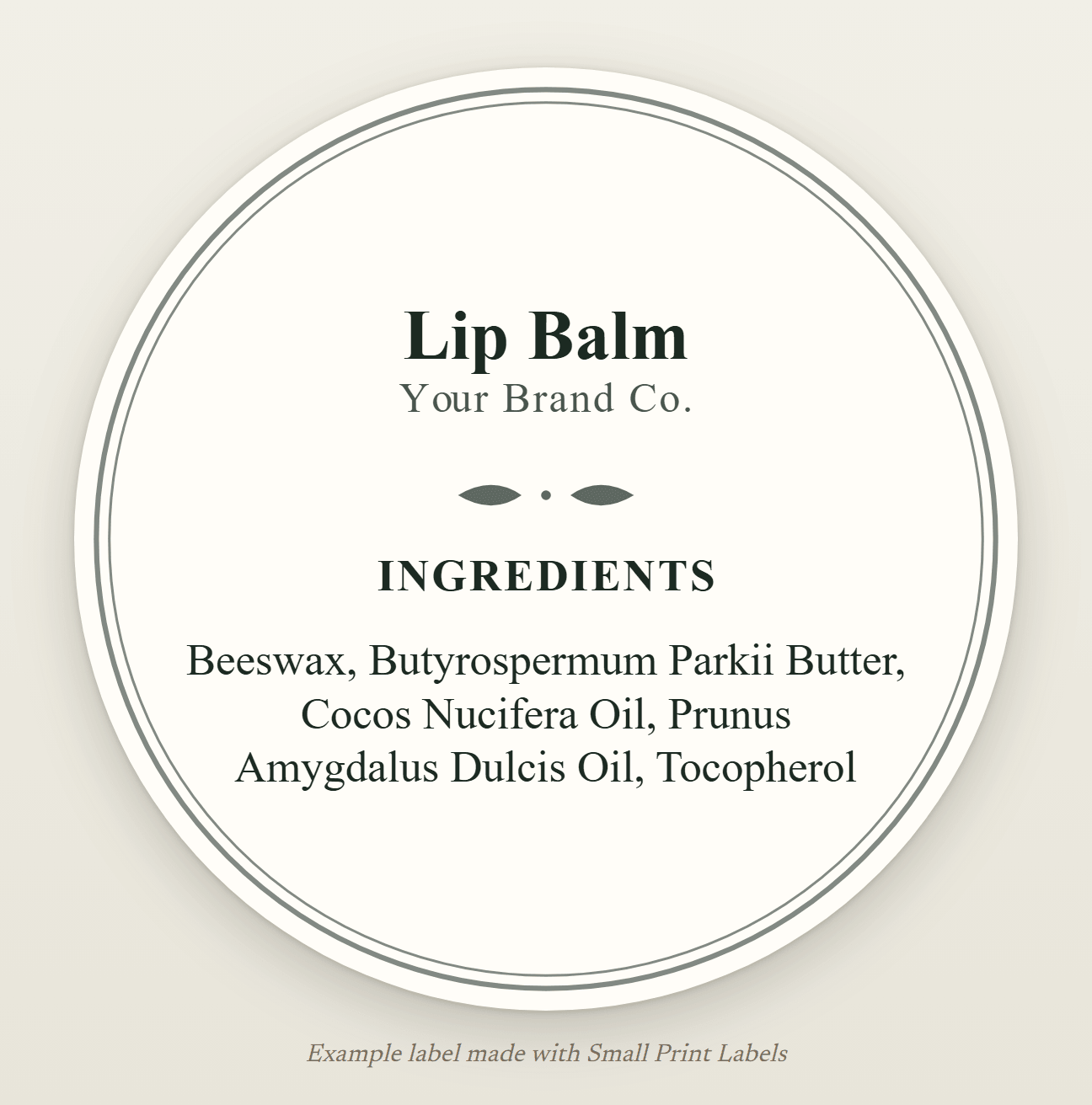
Five ingredients, heaviest first. With no fragrance there are no allergens to name. Beeswax is listed by its glossary name, Beeswax, and the shea butter and coconut oil, at the same weight, may come in either order.
The recipe, as typed into the skincare tool
Beeswax, 30
Shea butter, 25
Coconut oil, 25
Sweet almond oil, 19
Vitamin E, 1, inci: Tocopherol
Region: European Union. Product type: leave-on.
The ingredient list it printed
Beeswax, Butyrospermum Parkii Butter, Cocos Nucifera Oil, Prunus Amygdalus Dulcis Oil, Tocopherol
| Name on the label | % of product | Type |
|---|---|---|
| Beeswax | 30.00 | oil / butter |
| Butyrospermum Parkii Butter | 25.00 | oil / butter |
| Cocos Nucifera Oil | 25.00 | oil / butter |
| Prunus Amygdalus Dulcis Oil | 19.00 | oil / butter |
| Tocopherol | 1.00 | other |
Body lotion bottle
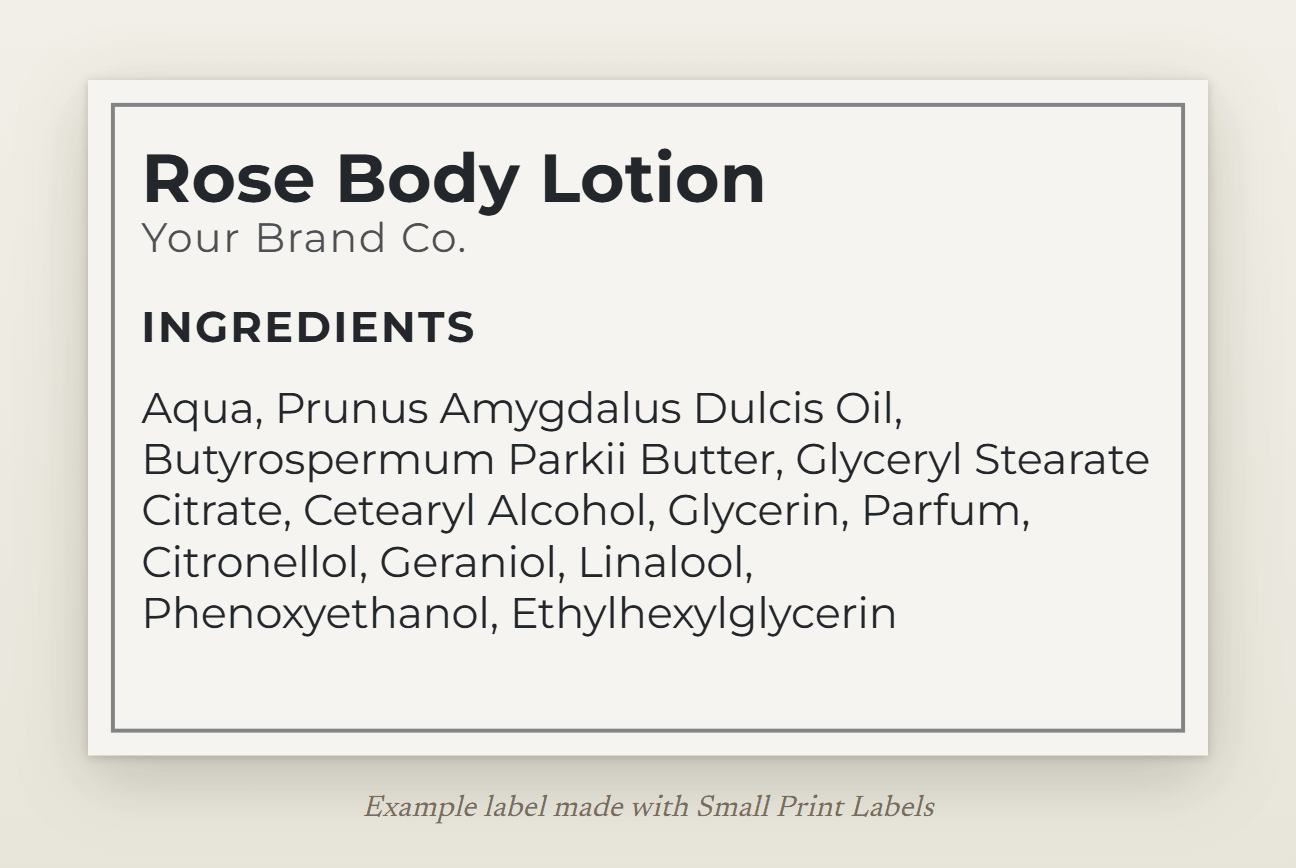
Water leads because the lotion is mostly water. The tool knows cetearyl alcohol, glycerin and phenoxyethanol by name; the emulsifier glyceryl stearate citrate and the ethylhexylglycerin are typed with their supplier's INCI names after inci: and printed as entered. Phenoxyethanol is a preservative in Annex V, which allows at most 1 % in the ready-for-use product; this lotion has 0.9 %. Each allergen from the rose fragrance is over the 0.001 % leave-on limit, and ingredients under 1 % may follow the rest in any order (Article 19(1)(g)).
The recipe, as typed into the skincare tool
Water, 73
Sweet almond oil, 10
Shea butter, 5
Glyceryl stearate citrate, 3, inci: Glyceryl Stearate Citrate
Cetearyl alcohol, 3
Glycerin, 3
Rose fragrance oil, 2, fragrance | Citronellol 12, Geraniol 8, Linalool 5
Phenoxyethanol, 0.9
Ethylhexylglycerin, 0.1, inci: Ethylhexylglycerin
Region: European Union. Product type: leave-on.
The ingredient list it printed
Aqua, Prunus Amygdalus Dulcis Oil, Butyrospermum Parkii Butter, Glyceryl Stearate Citrate, Cetearyl Alcohol, Glycerin, Parfum, Citronellol, Geraniol, Linalool, Phenoxyethanol, Ethylhexylglycerin
| Name on the label | % of product | Type |
|---|---|---|
| Aqua | 73.00 | water |
| Prunus Amygdalus Dulcis Oil | 10.00 | oil / butter |
| Butyrospermum Parkii Butter | 5.00 | oil / butter |
| Glyceryl Stearate Citrate | 3.00 | other |
| Cetearyl Alcohol | 3.00 | other |
| Glycerin | 3.00 | other |
| Parfum | 2.00 | fragrance |
| Citronellol | 0.24 | allergen, over the 0.001 % limit |
| Geraniol | 0.16 | allergen, over the 0.001 % limit |
| Linalool | 0.10 | allergen, over the 0.001 % limit |
| Phenoxyethanol | 0.90 | other |
| Ethylhexylglycerin | 0.10 | other |
Beard oil bottle
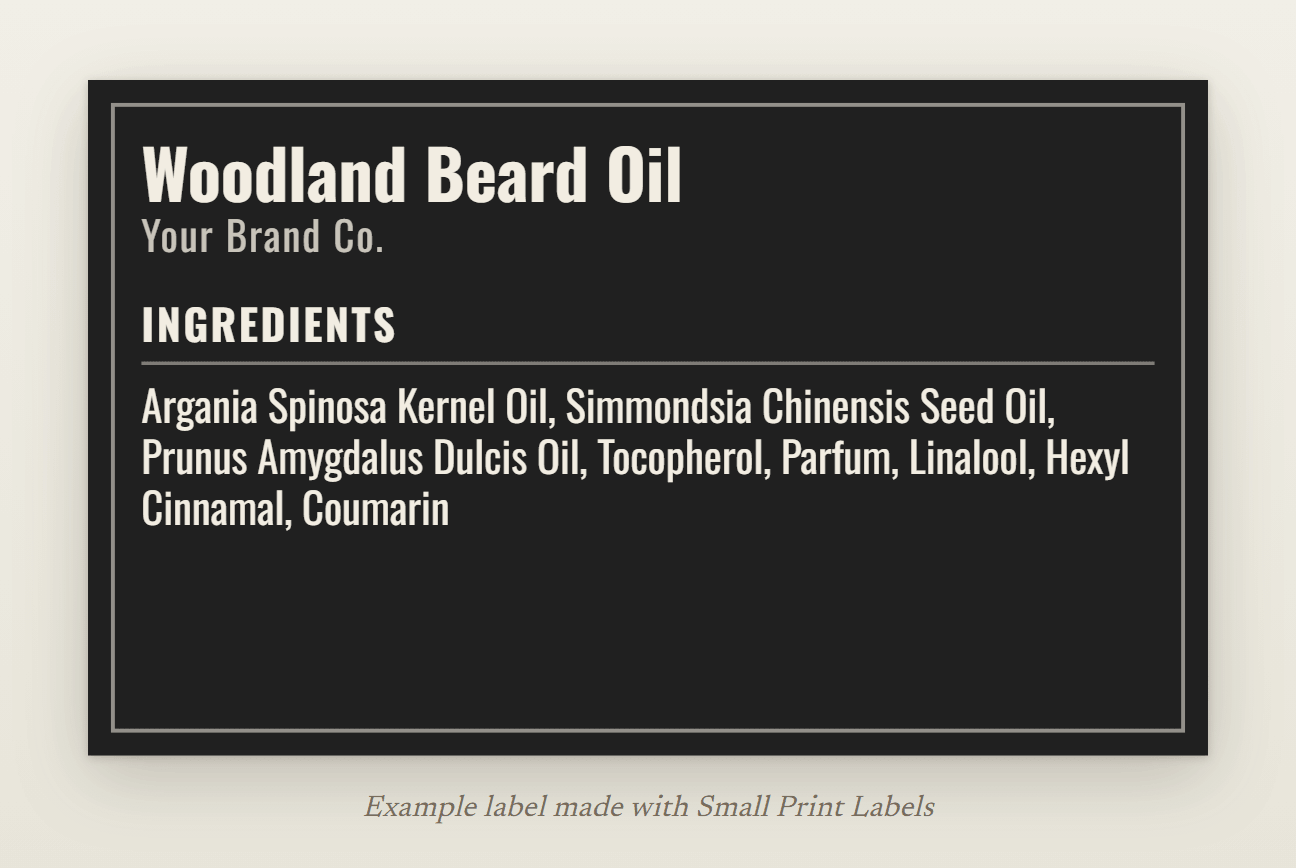
Argan and jojoba oil, at the same weight, may come in either order. The fragrance oil is 1 % of the bottle, and each of its three allergens is over the 0.001 % leave-on limit, so all three are named.
The recipe, as typed into the skincare tool
Argan oil, 40
Jojoba oil, 40
Sweet almond oil, 18
Vitamin E, 1, inci: Tocopherol
Woody fragrance oil, 1, fragrance | Linalool 10, Hexyl Cinnamal 5, Coumarin 2
Region: European Union. Product type: leave-on.
The ingredient list it printed
Argania Spinosa Kernel Oil, Simmondsia Chinensis Seed Oil, Prunus Amygdalus Dulcis Oil, Tocopherol, Parfum, Linalool, Hexyl Cinnamal, Coumarin
| Name on the label | % of product | Type |
|---|---|---|
| Argania Spinosa Kernel Oil | 40.00 | oil / butter |
| Simmondsia Chinensis Seed Oil | 40.00 | oil / butter |
| Prunus Amygdalus Dulcis Oil | 18.00 | oil / butter |
| Tocopherol | 1.00 | other |
| Parfum | 1.00 | fragrance |
| Linalool | 0.10 | allergen, over the 0.001 % limit |
| Hexyl Cinnamal | 0.05 | allergen, over the 0.001 % limit |
| Coumarin | 0.02 | allergen, over the 0.001 % limit |
What else goes on a skincare label
The labels above carry the ingredient list and a brand block. In the EU and Northern Ireland, Article 19(1) of Regulation (EC) No 1223/2009 asks the container and packaging for more: the responsible person's name and address, the nominal content, a batch number, the date of minimum durability or the period after opening, the product's function where it is not obvious, and any precautions. Great Britain's version of the regulation lists the same particulars.
In the US a lotion or a balm is a cosmetic, so its ingredient list is required, in letters at least 1/16 inch high (21 CFR 701.3(b)). The package also needs the product's identity, the net quantity in ounces or fluid ounces and the name and place of business of the maker, packer or distributor (21 CFR 701.11 to 701.13), and a US address, US phone number or website where people can report adverse reactions (21 U.S.C. 364e(a)).
Questions makers ask
Can I download these cosmetic label templates?
These pictures are examples, made from the recipes on this page, so they are not files to print. The same templates are in the skincare tool: paste your own recipe, pick one, and the tool writes your ingredient list into it. Building and previewing the label is free; the print-ready PDF, PNG or SVG download is the paid step.
Why is Aqua first on a lotion label?
Because the list runs in descending order of weight at the time the ingredients are added (Article 19(1)(g)), and a lotion is mostly water. Aqua is water's name in the EU glossary of ingredient names; a US label says Water.
Do I have to list the preservative?
Yes. Article 19(1)(g) lists the ingredients by weight, and a preservative is an ingredient like any other. Below 1 % it may come anywhere after the ingredients above 1 %, which is why the examples put it near the end.
What is the difference between leave-on and rinse-off?
A rinse-off product is meant to be removed after it is applied, like soap or a shower gel; a leave-on product is meant to stay in prolonged contact with the skin, like a lotion or a balm (the preamble to Annexes II to VI of Regulation (EC) No 1223/2009). A fragrance allergen is named over 0.01 % in a rinse-off product and over 0.001 % in a leave-on one.
Read before you print
- EU soap label requirements, explained for makers
- How do I list a fragrance oil on a soap label?
- Fragrance allergen calculator for soap and cosmetics
- Do you need a barcode to sell handmade products?
- Selling handmade soap into the EU from the UK: the label
- Does an online-only shop still need a label on the soap?
- Can I say "natural" or "chemical-free" on a soap label?
More label examples
Sources
- Regulation (EC) No 1223/2009 on cosmetic products, consolidated 18.05.2026, CELEX 02009R1223: Article 19(1), including 19(1)(g), the ingredient list; the preamble to Annexes II to VI, points 1(a) and 1(b), the rinse-off and leave-on definitions; Annex III, the fragrance-allergen entries and their 0,001 % and 0,01 % declaration conditions
- Commission Regulation (EU) 2023/1545 (CELEX 32023R1545), which extended the fragrance-allergen entries of Annex III, essential oils named in their own right among them
- Commission Implementing Decision (EU) 2025/1175, the glossary of common ingredient names (in application from 30 July 2026): the botanical names of the oils and butters
- 21 CFR 701.3(b), 701.11, 701.12 and 701.13 (US ingredient list, identity, name and place of business, net quantity), eCFR; 21 U.S.C. 364e(a) (the adverse-event contact on a cosmetic's label)
The same documents our rule tables are transcribed from and checked against. The recipes, brand names and supplier figures in the examples are made up for illustration. A labelling reference, not legal advice; you remain responsible for your product's labelling.