Label examples / Soap label examples
Soap label examples
Published 27 September 2026; rules last checked 25 September 2026. A labelling reference, not legal advice.
Six soap labels, each made in the soap tool from the recipe printed under it. The ingredient lists are the tool's own output on the current rules for each region, and the looks are templates from its designer. Use them for ideas, or put your own recipe in and start from the same template: seeing and copying the ingredient list is free, and you pay only to export the finished label.
In each one, look for three things: the oils named as the salts they become in the bar, Parfum for the scent, and after it each fragrance allergen over the limit for a product that is rinsed off. The first two examples are the same soap, labelled for the EU and for the US.
Lavender bar soap (EU)
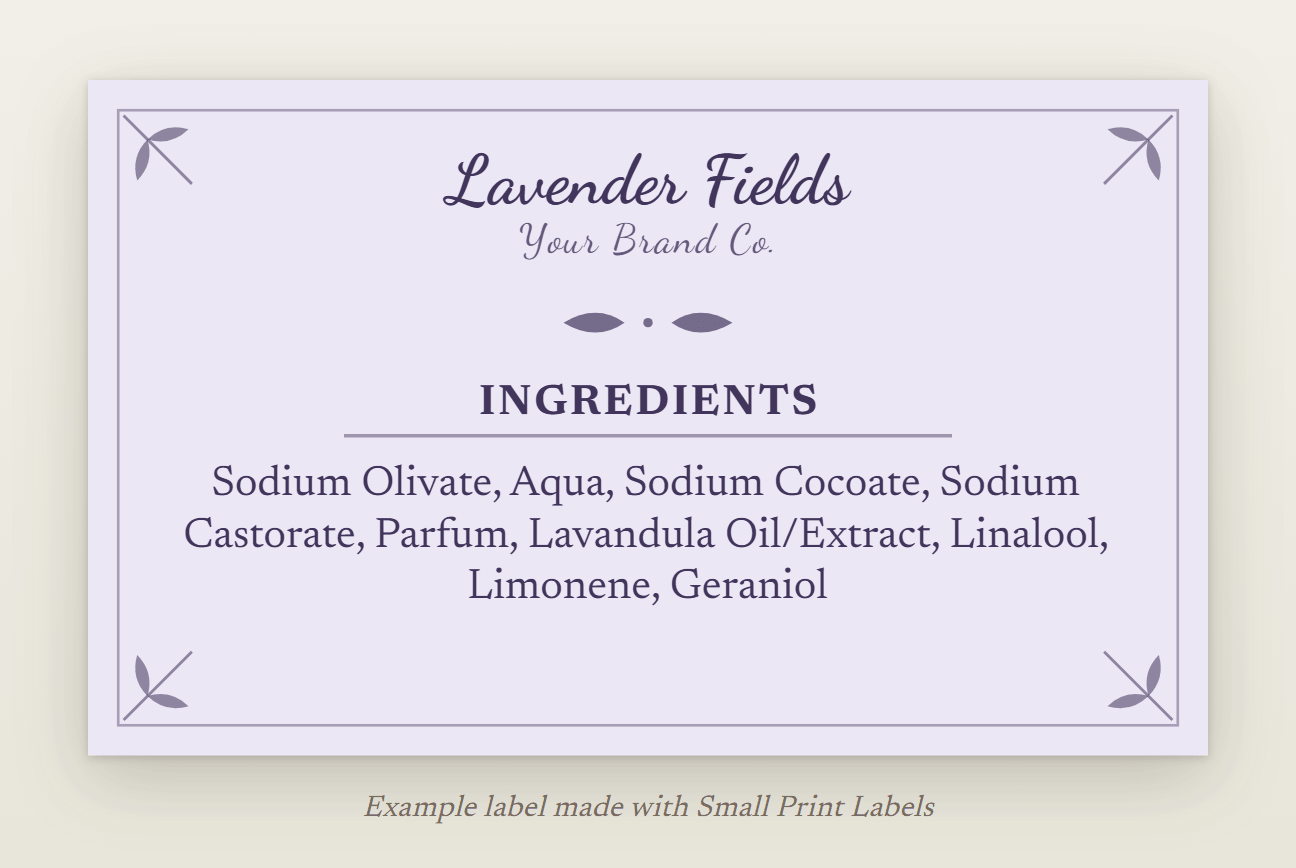
Olive, coconut and castor oil are named as their sodium salts, the usual "as made" way of listing soap, with the lye not listed separately. Lavender oil appears three times: as Parfum, as Lavandula Oil/Extract, because Regulation (EU) 2023/1545 put the oil itself on the list of substances to name, and as the three allergens it carries over the 0.01 % limit for a product that is rinsed off.
The recipe, as typed into the soap tool
Olive oil, 600
Coconut oil, 300
Castor oil, 100
Water, 330
Sodium hydroxide, 140
Lavender essential oil, 30 | Linalool 38, Limonene 1, Geraniol 1
Region: European Union. Product type: cold-process soap.
The ingredient list it printed
Sodium Olivate, Aqua, Sodium Cocoate, Sodium Castorate, Parfum, Lavandula Oil/Extract, Linalool, Limonene, Geraniol
| Name on the label | % of product | Type |
|---|---|---|
| Sodium Olivate | 44.12 | saponified oil |
| Aqua | 24.26 | water |
| Sodium Cocoate | 22.06 | saponified oil |
| Sodium Castorate | 7.35 | saponified oil |
| Parfum | 2.21 | fragrance |
| Lavandula Oil/Extract | 2.21 | allergen, over the 0.01 % limit |
| Linalool | 0.84 | allergen, over the 0.01 % limit |
| Limonene | 0.02 | allergen, over the 0.01 % limit |
| Geraniol | 0.02 | allergen, over the 0.01 % limit |
The same soap for the US
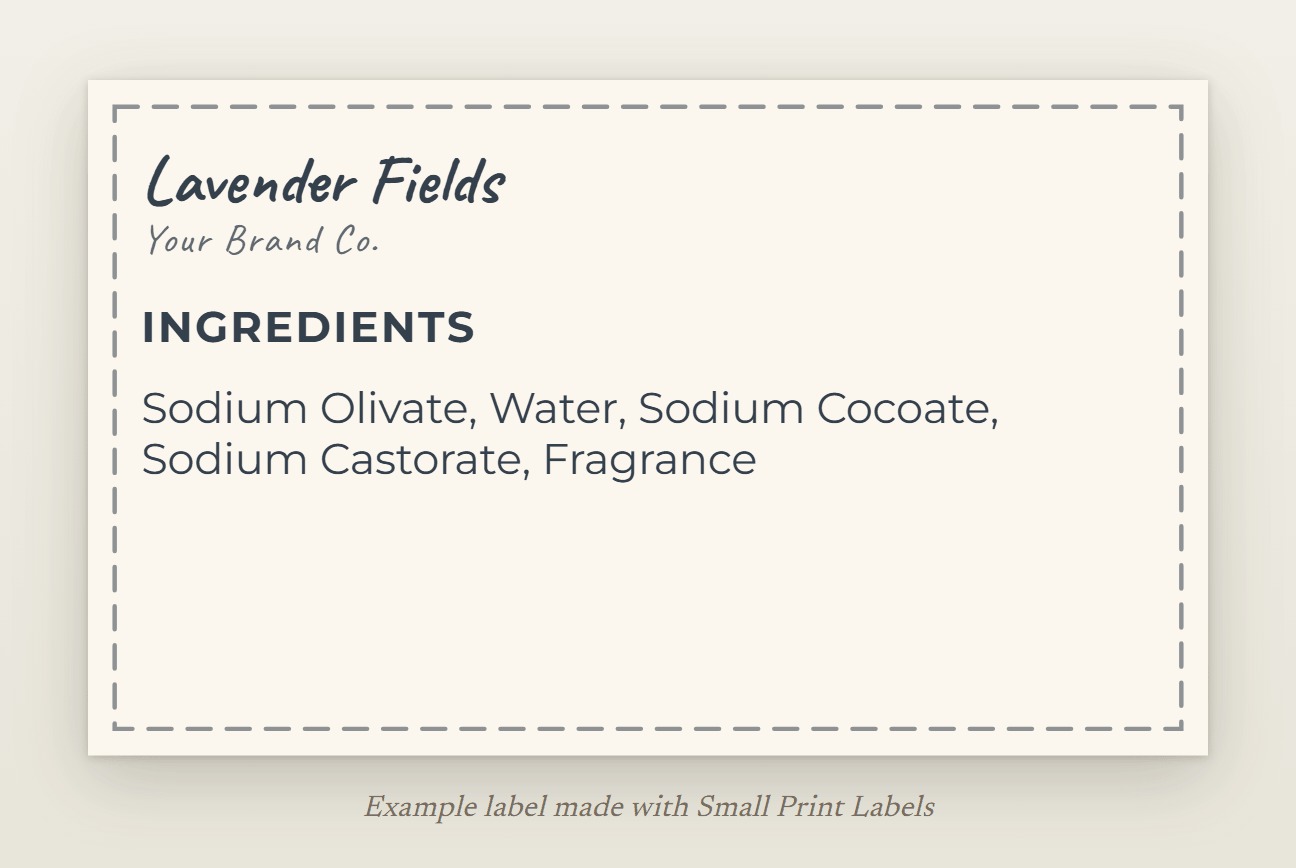
The same recipe with FDA's names: Water rather than Aqua, and Fragrance rather than Parfum. No allergens are named, because the US has no fragrance-allergen labelling rule in force yet. For a true soap, one that makes no cosmetic claims, the ingredient list is voluntary (21 CFR 701.20); the FTC's packaging rules (16 CFR 500) ask its package for the product's identity, the maker's name and place of business, and the net quantity in US and metric units.
The recipe, as typed into the soap tool
Olive oil, 600
Coconut oil, 300
Castor oil, 100
Water, 330
Sodium hydroxide, 140
Lavender essential oil, 30 | Linalool 38, Limonene 1, Geraniol 1
Region: United States. Product type: cold-process soap.
The ingredient list it printed
Sodium Olivate, Water, Sodium Cocoate, Sodium Castorate, Fragrance
| Name on the label | % of product | Type |
|---|---|---|
| Sodium Olivate | 44.12 | saponified oil |
| Water | 24.26 | water |
| Sodium Cocoate | 22.06 | saponified oil |
| Sodium Castorate | 7.35 | saponified oil |
| Fragrance | 2.21 | fragrance |
Rose fragrance-oil soap (UK)
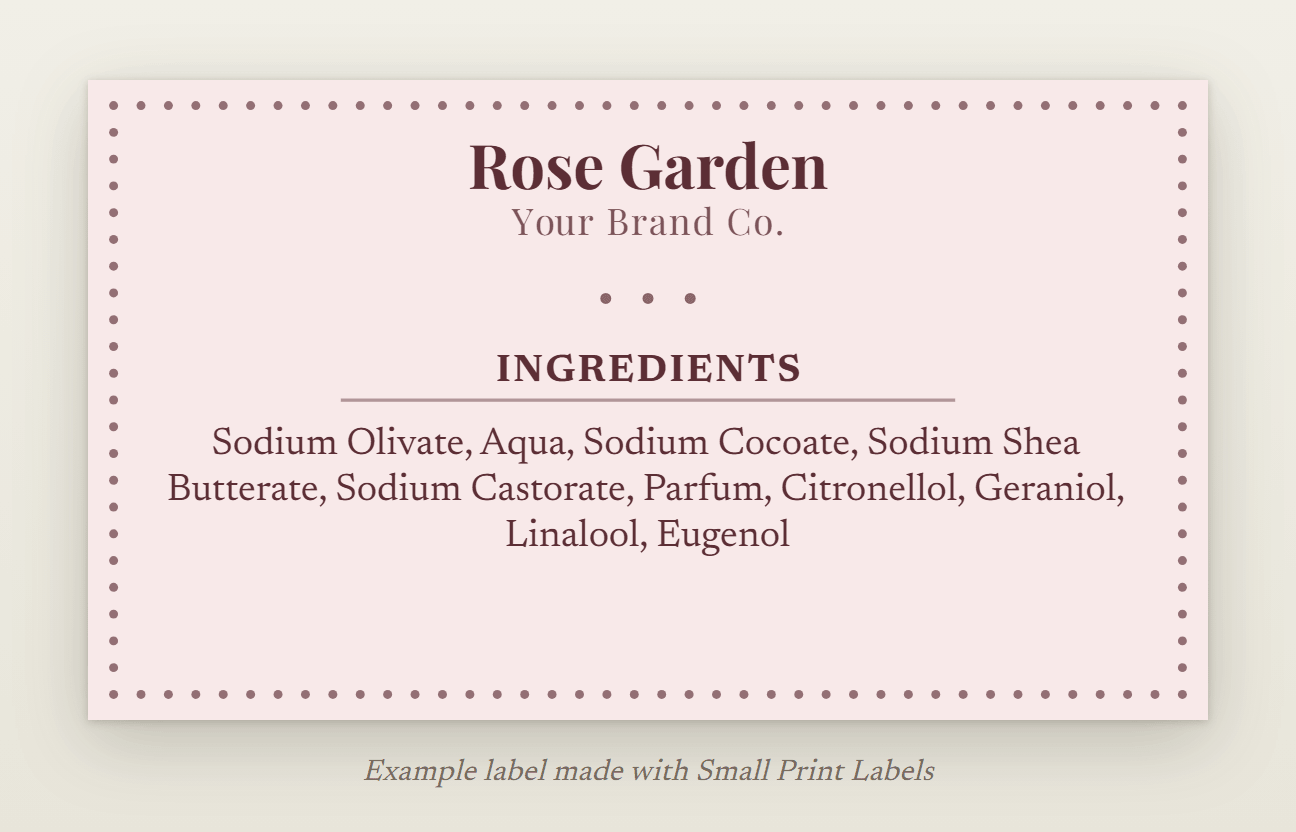
Great Britain still uses its own, shorter list of 25 fragrance allergens. All four in this fragrance oil, citronellol, geraniol, linalool and eugenol, are on it and each is over 0.01 % of the bar, so each is named after Parfum. The shea butter is saponified with the other oils here, so it appears as Sodium Shea Butterate.
The recipe, as typed into the soap tool
Olive oil, 400
Coconut oil, 300
Shea butter, 200
Castor oil, 100
Water, 330
Sodium hydroxide, 140
Rose fragrance oil, 30, fragrance | Citronellol 12, Geraniol 8, Linalool 5, Eugenol 1
Region: Great Britain (UK). Product type: cold-process soap.
The ingredient list it printed
Sodium Olivate, Aqua, Sodium Cocoate, Sodium Shea Butterate, Sodium Castorate, Parfum, Citronellol, Geraniol, Linalool, Eugenol
| Name on the label | % of product | Type |
|---|---|---|
| Sodium Olivate | 29.41 | saponified oil |
| Aqua | 24.26 | water |
| Sodium Cocoate | 22.06 | saponified oil |
| Sodium Shea Butterate | 14.71 | saponified oil |
| Sodium Castorate | 7.35 | saponified oil |
| Parfum | 2.21 | fragrance |
| Citronellol | 0.26 | allergen, over the 0.01 % limit |
| Geraniol | 0.18 | allergen, over the 0.01 % limit |
| Linalool | 0.11 | allergen, over the 0.01 % limit |
| Eugenol | 0.02 | allergen, over the 0.01 % limit |
Liquid soap (potassium)
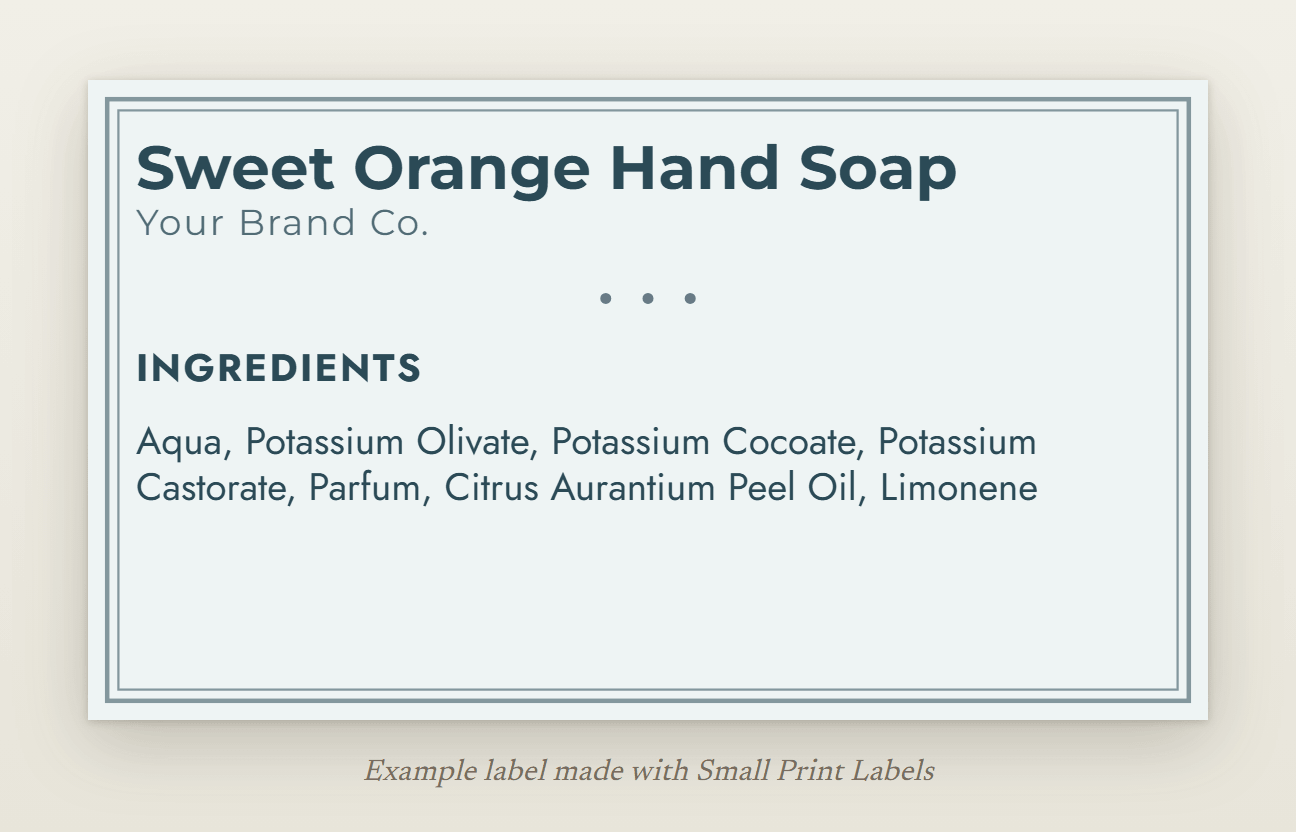
Soap made with potassium hydroxide takes the potassium salt names: Potassium Olivate, Potassium Cocoate and Potassium Castorate. Water leads because a liquid soap is mostly water. Sweet orange oil is named as Parfum, as the oil itself (Citrus Aurantium Peel Oil) and as limonene; its linalool stays under the 0.01 % limit, so the label does not name it.
The recipe, as typed into the soap tool
Olive oil, 400
Coconut oil, 300
Castor oil, 100
Water, 1200
Potassium hydroxide, 180
Sweet orange essential oil, 20 | Limonene 94, Linalool 0.5
Region: European Union. Product type: cold-process soap.
The ingredient list it printed
Aqua, Potassium Olivate, Potassium Cocoate, Potassium Castorate, Parfum, Citrus Aurantium Peel Oil, Limonene
| Name on the label | % of product | Type |
|---|---|---|
| Aqua | 59.41 | water |
| Potassium Olivate | 19.80 | saponified oil |
| Potassium Cocoate | 14.85 | saponified oil |
| Potassium Castorate | 4.95 | saponified oil |
| Parfum | 0.99 | fragrance |
| Citrus Aurantium Peel Oil | 0.99 | allergen, over the 0.01 % limit |
| Limonene | 0.93 | allergen, over the 0.01 % limit |
Amber fragrance-oil soap (EU)
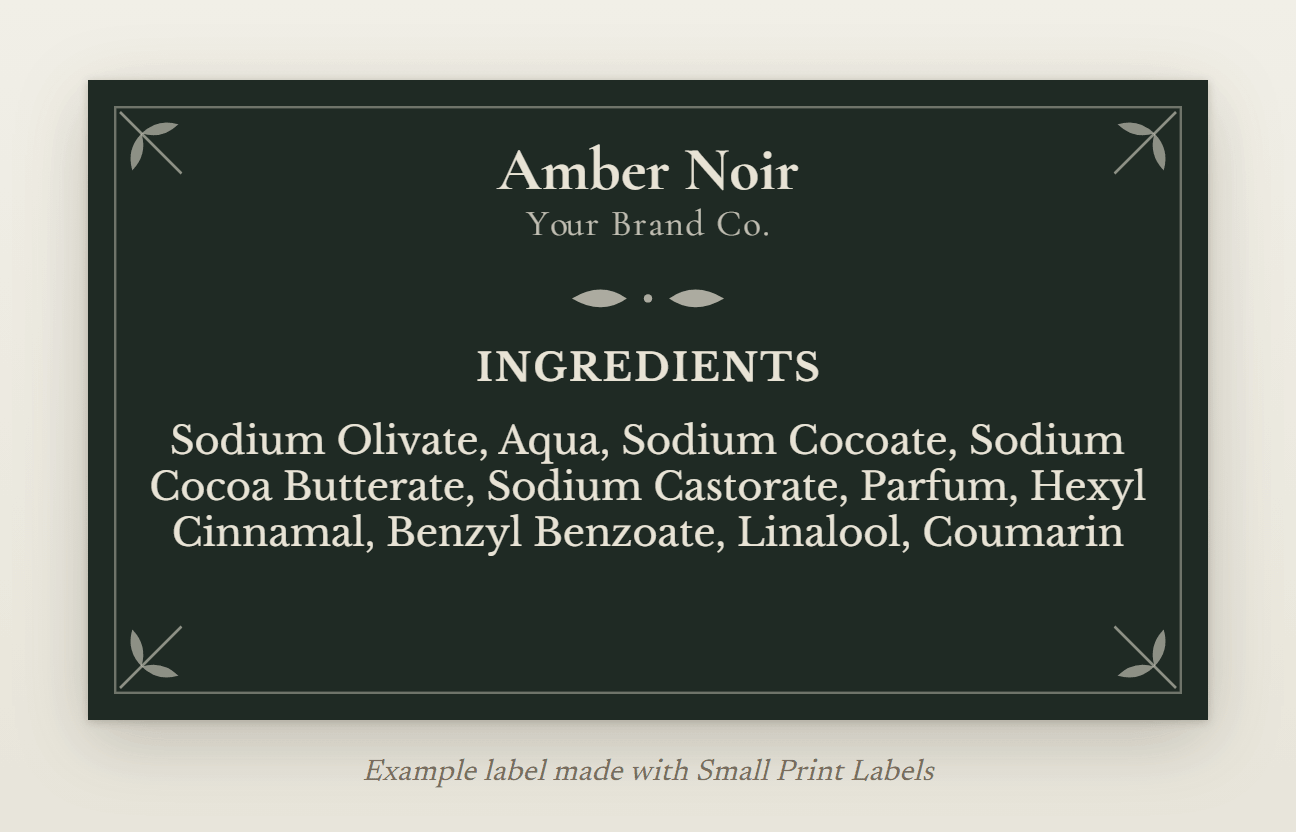
A fragrance oil is named as Parfum, then each allergen from the supplier's breakdown that is over 0.01 % of the bar: hexyl cinnamal, benzyl benzoate, linalool and coumarin. Saponified cocoa butter becomes Sodium Cocoa Butterate.
The recipe, as typed into the soap tool
Olive oil, 450
Coconut oil, 300
Cocoa butter, 150
Castor oil, 100
Water, 330
Sodium hydroxide, 140
Amber fragrance oil, 40, fragrance | Coumarin 3, Linalool 4, Hexyl Cinnamal 6, Benzyl Benzoate 5
Region: European Union. Product type: cold-process soap.
The ingredient list it printed
Sodium Olivate, Aqua, Sodium Cocoate, Sodium Cocoa Butterate, Sodium Castorate, Parfum, Hexyl Cinnamal, Benzyl Benzoate, Linalool, Coumarin
| Name on the label | % of product | Type |
|---|---|---|
| Sodium Olivate | 32.85 | saponified oil |
| Aqua | 24.09 | water |
| Sodium Cocoate | 21.90 | saponified oil |
| Sodium Cocoa Butterate | 10.95 | saponified oil |
| Sodium Castorate | 7.30 | saponified oil |
| Parfum | 2.92 | fragrance |
| Hexyl Cinnamal | 0.18 | allergen, over the 0.01 % limit |
| Benzyl Benzoate | 0.15 | allergen, over the 0.01 % limit |
| Linalool | 0.12 | allergen, over the 0.01 % limit |
| Coumarin | 0.09 | allergen, over the 0.01 % limit |
Peppermint soap on kraft (EU)
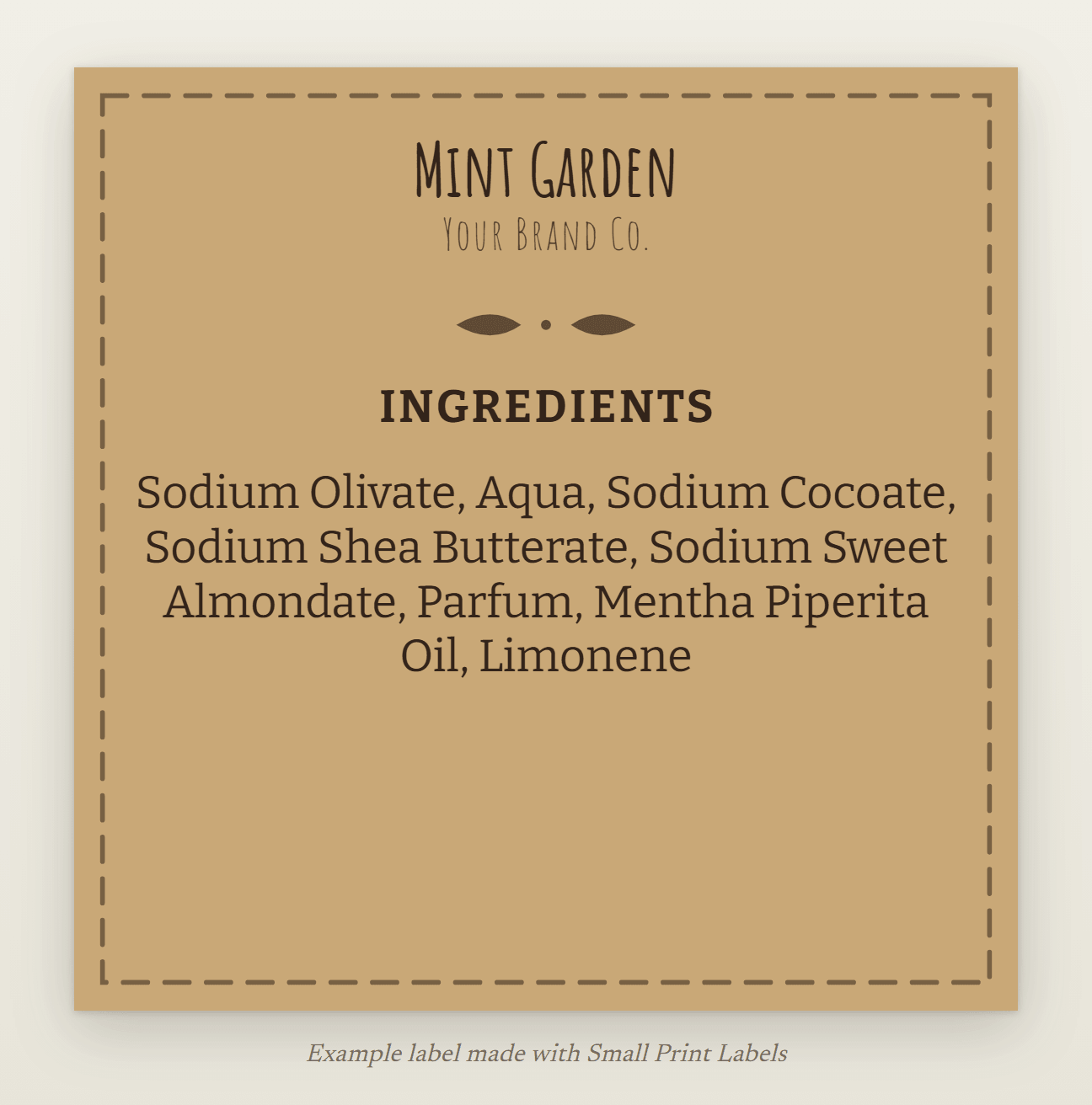
Peppermint oil is on the EU list in its own right, as Mentha Piperita Oil, and its limonene is over 0.01 % of the bar. Its linalool stays under the limit, so the label does not name it. That is checked against the cured bars, weighed on the last line, because a bar loses water as it cures and every allergen becomes a larger share of it. Sweet almond oil, saponified, becomes Sodium Sweet Almondate.
The recipe, as typed into the soap tool
Olive oil, 400
Coconut oil, 300
Shea butter, 200
Sweet almond oil, 100
Water, 330
Sodium hydroxide, 140
Peppermint essential oil, 25 | Limonene 2, Linalool 0.5
Cured weight, 1390
Region: European Union. Product type: cold-process soap.
The ingredient list it printed
Sodium Olivate, Aqua, Sodium Cocoate, Sodium Shea Butterate, Sodium Sweet Almondate, Parfum, Mentha Piperita Oil, Limonene
| Name on the label | % of product | Type |
|---|---|---|
| Sodium Olivate | 29.52 | saponified oil |
| Aqua | 24.35 | water |
| Sodium Cocoate | 22.14 | saponified oil |
| Sodium Shea Butterate | 14.76 | saponified oil |
| Sodium Sweet Almondate | 7.38 | saponified oil |
| Parfum | 1.85 | fragrance |
| Mentha Piperita Oil | 1.85 | allergen, over the 0.01 % limit |
| Limonene | 0.04 | allergen, over the 0.01 % limit |
What else goes on a soap label
The labels above carry the ingredient list and a brand block. In the EU and Northern Ireland, Article 19(1) of Regulation (EC) No 1223/2009 asks the container and packaging for more: the responsible person's name and address, the nominal content, a batch number, the date of minimum durability or the period after opening, the product's function where it is not obvious, and any precautions. Great Britain's version of the regulation lists the same particulars.
In the US, a true soap needs no ingredient list at all (21 CFR 701.20), but its package follows the FTC's rules: the product's identity, the name and place of business of the manufacturer, packer or distributor, and the net quantity in both US and metric units (16 CFR 500). A soap sold with cosmetic claims is a cosmetic, and then the ingredient list is required. The EU soap label guide and the US soap label guide walk through each.
The templates
Each look is one of the designer's 22 templates, applied in one click and then yours to change: fonts, border, ornament, colours and size. Round stickers for tins and jar lids, portrait and square stock, and custom sizes from 20 to 210 mm are all there, and the ingredient list resizes itself to fit.
Questions makers ask
Can I download these soap label templates?
These pictures are examples, made from the recipes on this page, so they are not files to print. The same templates are in the soap tool: paste your own recipe, pick one, and the tool writes your ingredient list into it. Building and previewing the label is free; the print-ready PDF, PNG or SVG download is the paid step.
Why does a soap label say Sodium Olivate instead of olive oil?
Because saponification turns each oil into a salt, and the usual way of listing soap names what is in the finished bar: olive oil made into soap with sodium hydroxide is Sodium Olivate in the EU glossary of ingredient names, coconut oil is Sodium Cocoate. Article 19(1)(g) orders ingredients by weight "at the time they are added", which also supports listing the oils and the sodium hydroxide as added; the tool notes both.
Do I have to list the allergens in an essential oil?
In the EU and Northern Ireland, each fragrance allergen on the current list that is over 0.01 % of a rinse-off product such as soap, or 0.001 % of a leave-on product, is named after Parfum, and since Regulation (EU) 2023/1545 some essential oils, lavender and peppermint among them, are named in their own right too. Great Britain uses its own list of 25 with the same limits. The US names none yet.
What size should a soap label be?
Whatever fits your packaging. The EU and UK rules set no size for a cosmetic label, only "indelible, easily legible and visible lettering" (Article 19(1)); a US cosmetic's ingredient list needs letters at least 1/16 inch high (21 CFR 701.3(b)). The tool offers common stock sizes, round stickers and custom sizes, and says when the list would print small.
Read before you print
- EU soap label requirements, explained for makers
- US soap label requirements, explained for makers
- How do I list a fragrance oil on a soap label?
- Fragrance allergen calculator for soap and cosmetics
- Do you need a barcode to sell handmade products?
- Do I have to list sodium hydroxide on a soap label?
- Selling handmade soap into the EU from the UK: the label
- Melt-and-pour and liquid soap labels: what to list
- Does an online-only shop still need a label on the soap?
- Can I say "natural" or "chemical-free" on a soap label?
More label examples
Sources
- Regulation (EC) No 1223/2009 on cosmetic products, consolidated 18.05.2026, CELEX 02009R1223: Article 19(1), including 19(1)(g), the ingredient list; Annex III, the fragrance-allergen entries and their 0,001 % and 0,01 % declaration conditions
- Commission Regulation (EU) 2023/1545 (CELEX 32023R1545), which extended the fragrance-allergen entries of Annex III, essential oils named in their own right among them
- Regulation (EC) No 1223/2009 as it applies in Great Britain (assimilated law), Article 19 and Annex III (the 25 entries carrying the declaration condition), legislation.gov.uk, text current to 15 August 2026
- Commission Implementing Decision (EU) 2025/1175, the glossary of common ingredient names (in application from 30 July 2026): the sodium and potassium salt names of the oils
- 21 CFR 701.3 (ingredient declaration) and 21 CFR 701.20 (the soap definition), eCFR; 16 CFR 500 (the FTC's packaging rules); FDA's Global Substance Registration System for the US ingredient names
The same documents our rule tables are transcribed from and checked against. The recipes, brand names and supplier figures in the examples are made up for illustration. A labelling reference, not legal advice; you remain responsible for your product's labelling.