Label examples / US reed diffuser and room spray label examples
US reed diffuser and room spray label examples
Published 28 September 2026; rules last checked 25 September 2026. A labelling reference, not legal advice.
Four US labels built in the home-fragrance tool: a reed diffuser that is combustible and an eye irritant, a diffuser with a petroleum-distillate base on front and back labels, an alcohol room spray, and a water-based linen spray that needs no warning at all. Each product's properties (flash point, irritancy, the components named) are made up for illustration. Building and previewing a label is free; you pay only to export it.
A US label carries no pictograms. When the finished liquid is flammable, combustible, toxic, an irritant or a strong sensitizer, the Federal Hazardous Substances Act puts a warning on it: a signal word and statements of hazard in capitals, boxed on the front, then the components behind the hazards, precautions, first aid and "Keep out of the reach of children". Every package, warning or not, also states what it is, the net contents in fluid ounces and millilitres, and your name and place of business.
Reed diffuser, combustible and an eye irritant
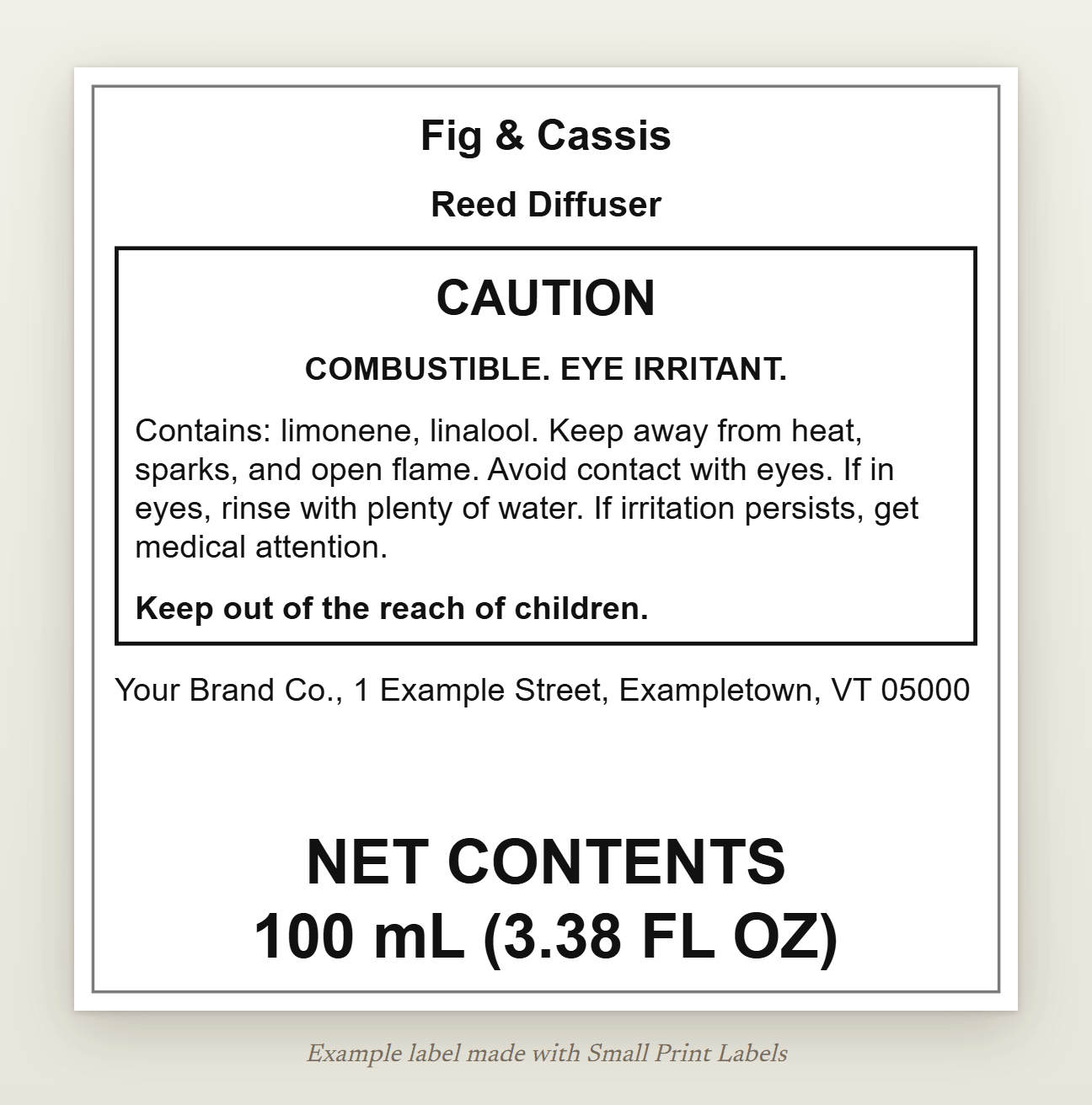
The finished liquid flashes at 140 °F in a closed-cup test, inside the combustible band of 100 °F to 150 °F (16 CFR 1500.3(c)(6)), and it irritates the eyes, so COMBUSTIBLE and EYE IRRITANT go in the box under the signal word. For these hazards the Act allows WARNING or CAUTION; this maker chose CAUTION. A product whose only hazard is being flammable may leave its components unnamed, but that exemption does not reach combustible (16 CFR 1500.83(a)(1)), so the components behind the hazards are named: limonene and linalool in this made-up case. Limonene is a hydrocarbon, but at 3 % of the product the diffuser is well under the 10 % that would call for a child-resistant closure.
What went into the home-fragrance tool
- Region
- United States
- Product
- Fig & Cassis, sold as "Reed Diffuser"
- Bottle
- Round, 3.5 in tall and 2.2 in across: a front panel of 9.7 sq in
- Flash point of the finished liquid
- 140 °F, closed cup: combustible
- Other hazards (the maker's data)
- an eye irritant
- Components to name
- limonene, linalool
- Hydrocarbons
- 3 % by weight, thinner than 100 SUS at 100 °F; sold with a cap
- Precautions and first aid
- The maker's own words, as below
- Layout
- One label
What the tool put on the label
- Signal word: CAUTION
- Statements of hazard: COMBUSTIBLE, EYE IRRITANT
- Components named: Contains: limonene, linalool.
- Precautions: Keep away from heat, sparks, and open flame. Avoid contact with eyes.
- First aid: If in eyes, rinse with plenty of water. If irritation persists, get medical attention.
- Children: Keep out of the reach of children.
- Name and place of business: Your Brand Co., 1 Example Street, Exampletown, VT 05000
- Net contents: NET CONTENTS 100 mL (3.38 FL OZ), in the bottom 30 % of the front
- Minimum letter heights (capitals, for a front panel of 9.7 sq in): signal word 3/32 in, statements of hazard 1/16 in, other cautions 1/16 in, net contents 1/8 in
- Child-resistant packaging: not required by what was entered
Reed diffuser with a petroleum-distillate base (front and back)
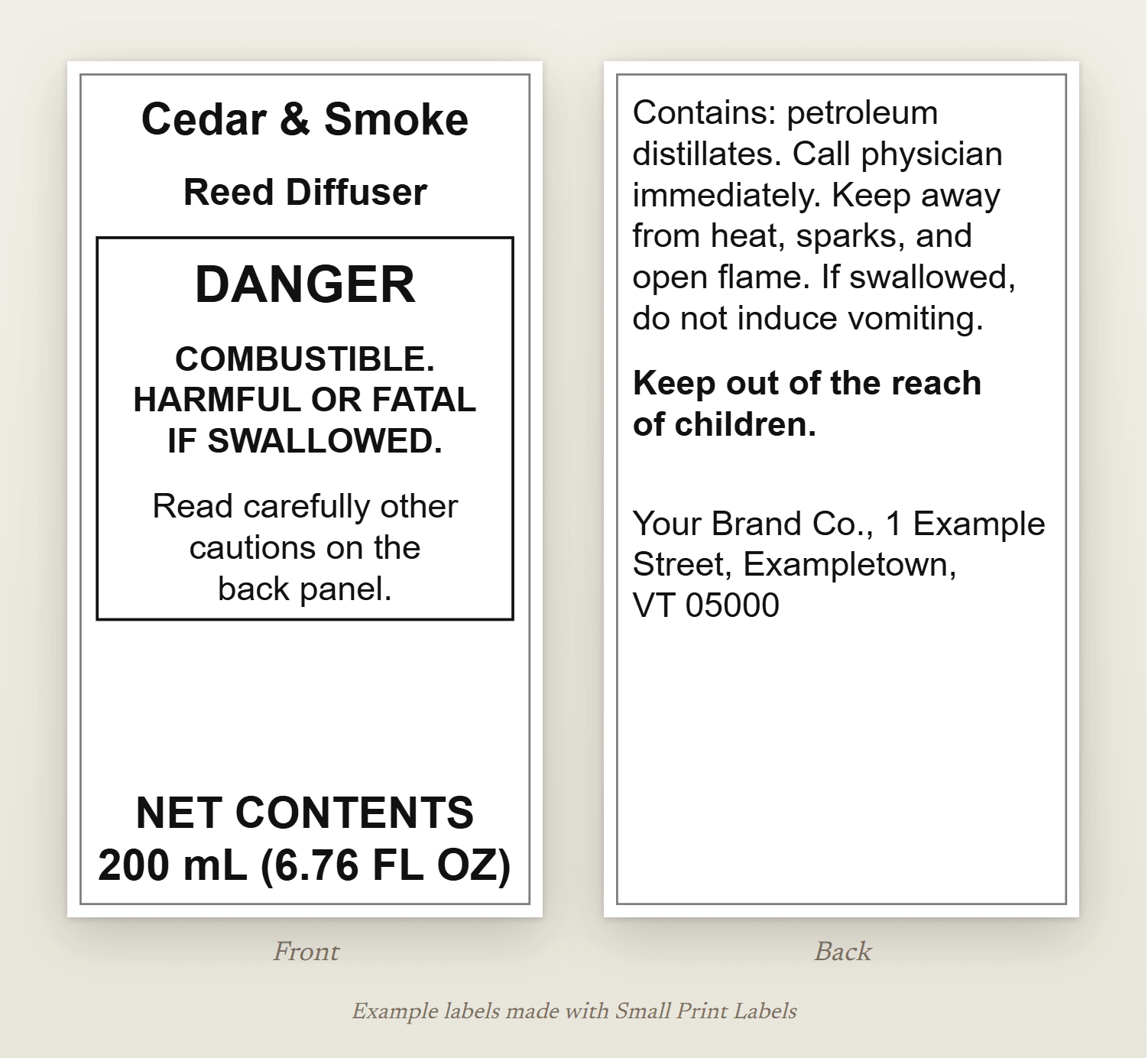
A base that is 10 % or more petroleum distillates by weight brings wording the regulation prescribes: the signal word DANGER, HARMFUL OR FATAL IF SWALLOWED and "Call physician immediately" (16 CFR 1500.14(b)(3)(ii)), because the liquid can be drawn into the lungs if it is swallowed. The front carries the signal word, the statements of hazard and the pointer to the back, boxed together (16 CFR 1500.121(b)(2)(ii)); the other cautions sit together on the back. The base also decides the bottle: a hazardous liquid with 10 % or more hydrocarbons and a viscosity under 100 SUS at 100 °F must be sold in child-resistant packaging (16 CFR 1700.14(a)(31)).
What went into the home-fragrance tool
- Region
- United States
- Product
- Cedar & Smoke, sold as "Reed Diffuser"
- Bottle
- Round, 4.5 in tall and 2.6 in across: a front panel of 14.7 sq in
- Flash point of the finished liquid
- 135 °F, closed cup: combustible
- Other hazards (the maker's data)
- petroleum distillates, 10 percent or more by weight
- Components to name
- none entered; the tool names the listed substance itself
- Hydrocarbons
- 70 % by weight, thinner than 100 SUS at 100 °F; sold with a cap
- Precautions and first aid
- The maker's own words, as below
- Layout
- Front and back labels, the other cautions on the back panel
What the tool put on the label
- Signal word: DANGER
- Statements of hazard: COMBUSTIBLE, HARMFUL OR FATAL IF SWALLOWED
- In the box on the front: Read carefully other cautions on the back panel.
- Components named: Contains: petroleum distillates.
- Prescribed by 16 CFR 1500.14: Call physician immediately.
- Precautions: Keep away from heat, sparks, and open flame.
- First aid: If swallowed, do not induce vomiting.
- Children: Keep out of the reach of children.
- Name and place of business: Your Brand Co., 1 Example Street, Exampletown, VT 05000
- Net contents: NET CONTENTS 200 mL (6.76 FL OZ), in the bottom 30 % of the front
- Minimum letter heights (capitals, for a front panel of 14.7 sq in): signal word 7/64 in, statements of hazard 3/32 in, other cautions 1/16 in, net contents 1/8 in
- Child-resistant packaging: required. It is a hazardous substance with 10 % or more hydrocarbons and a viscosity under 100 SUS at 100 °F (16 CFR 1700.14(a)(31)).
Room spray with alcohol (flammable)
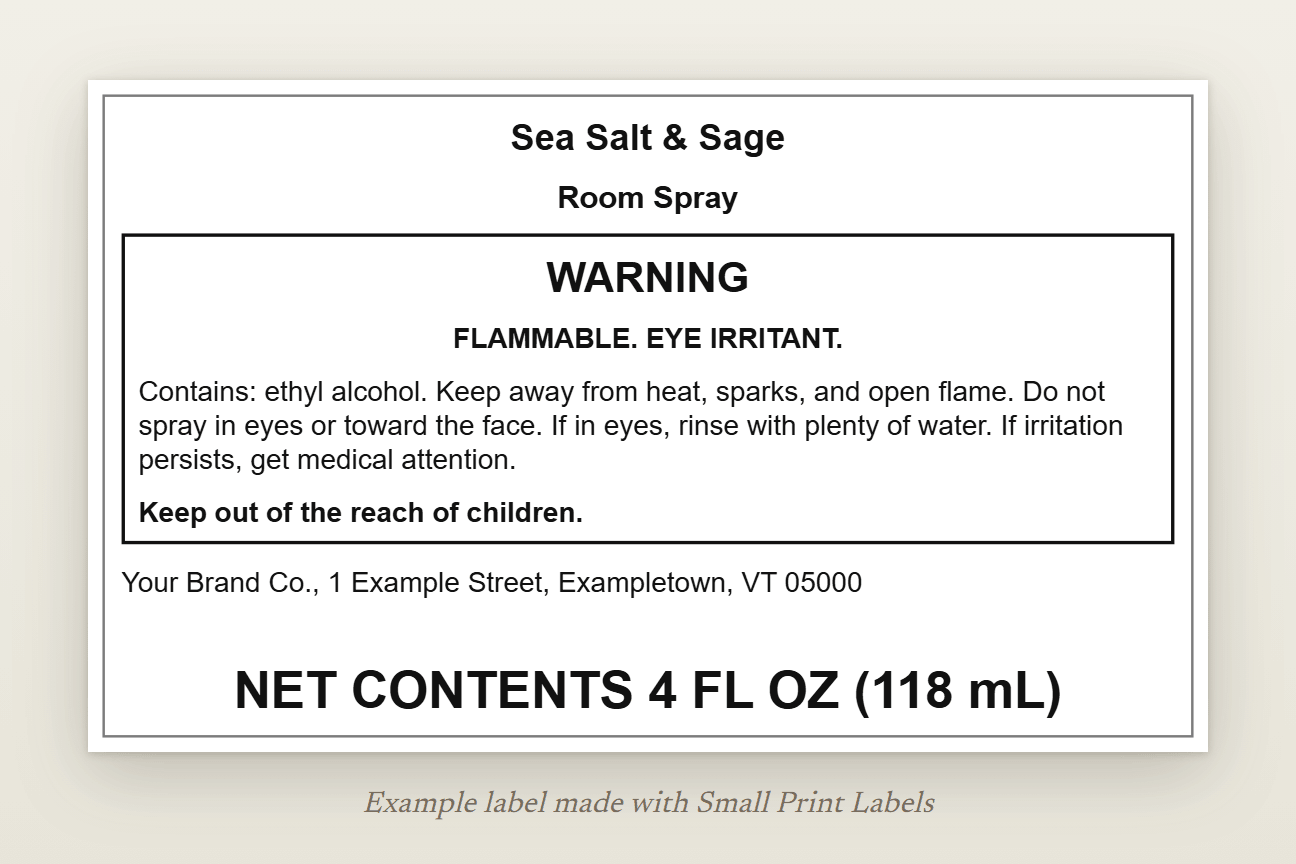
With a flash point of 70 °F the spray is FLAMMABLE, the band above 20 °F and below 100 °F (16 CFR 1500.3(c)(6)). Flammability alone would not need a component named, but the spray is also an eye irritant, so the label names ethyl alcohol (16 CFR 1500.83(a)(1)). The contents were entered in fluid ounces, so they come first: 4 fl oz is 118.29 mL, and the metric figure is cut to 118 mL, never rounded up, as in the regulation's own example "8 fl oz (236 mL)".
What went into the home-fragrance tool
- Region
- United States
- Product
- Sea Salt & Sage, sold as "Room Spray"
- Bottle
- Round, 2.9 in tall and 1.9 in across: a front panel of 6.9 sq in
- Flash point of the finished liquid
- 70 °F, closed cup: flammable
- Other hazards (the maker's data)
- an eye irritant
- Components to name
- ethyl alcohol
- Hydrocarbons
- 1 % by weight, thinner than 100 SUS at 100 °F; sold with a pump spray that unscrews
- Precautions and first aid
- The maker's own words, as below
- Layout
- One label
What the tool put on the label
- Signal word: WARNING
- Statements of hazard: FLAMMABLE, EYE IRRITANT
- Components named: Contains: ethyl alcohol.
- Precautions: Keep away from heat, sparks, and open flame. Do not spray in eyes or toward the face.
- First aid: If in eyes, rinse with plenty of water. If irritation persists, get medical attention.
- Children: Keep out of the reach of children.
- Name and place of business: Your Brand Co., 1 Example Street, Exampletown, VT 05000
- Net contents: NET CONTENTS 4 FL OZ (118 mL), in the bottom 30 % of the front
- Minimum letter heights (capitals, for a front panel of 6.9 sq in): signal word 3/32 in, statements of hazard 1/16 in, other cautions 1/16 in, net contents 1/8 in
- Child-resistant packaging: not required by what was entered
Water-based linen spray, not hazardous
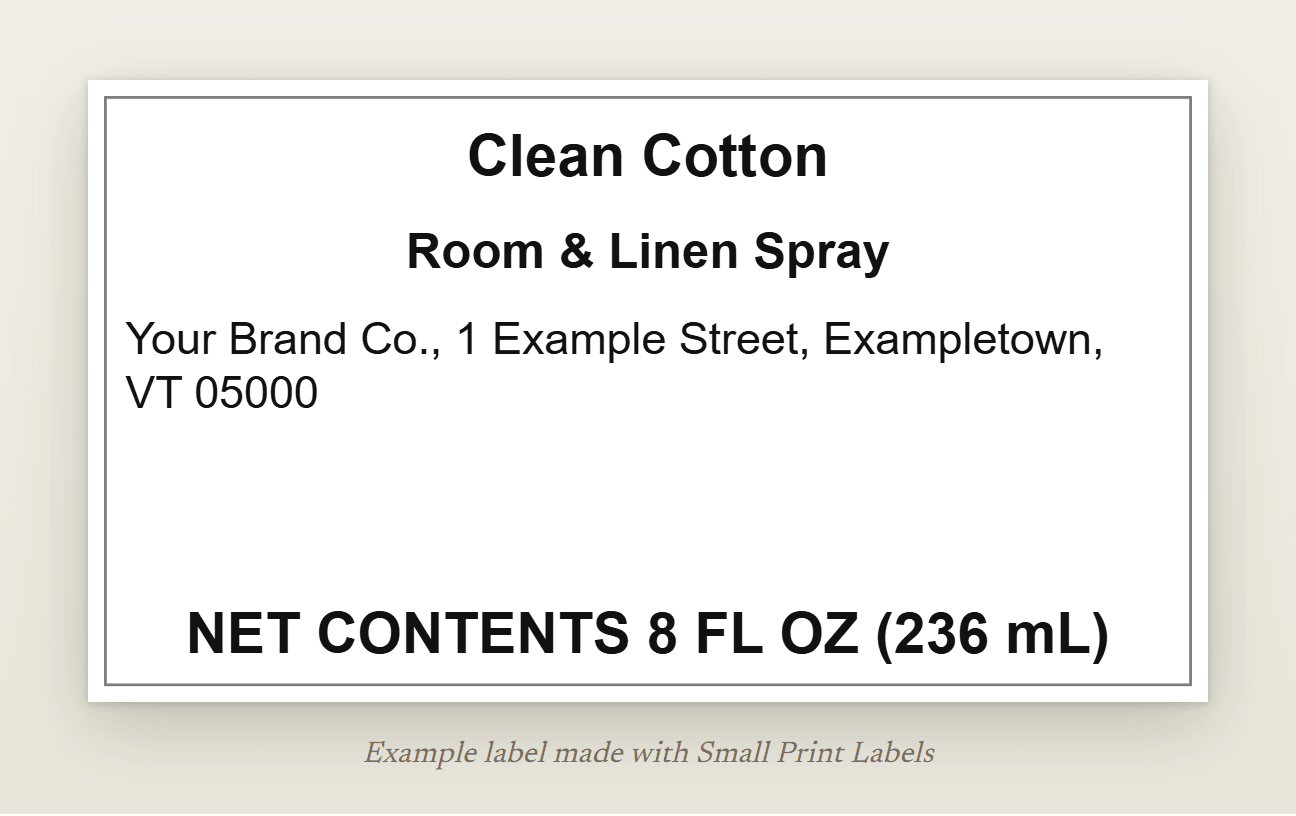
Its flash point, 97 °F, is under 100 °F, but the spray is a water solution with 20 % alcohol, and the rules do not treat such a solution (24 % alcohol or less by volume) as flammable or combustible when it presents no significant flammability hazard in consumer use (16 CFR 1500.3(c)(6)(ii)(B) and (iii)(B)). That judgement is the maker's, and the tool records it. With no other hazard the spray is not a hazardous substance under the FHSA, so there is no warning box: the label carries what every US package needs (16 CFR Part 500), what the product is, the maker's name and place of business, and the net contents in both units in the bottom 30 % of the front.
What went into the home-fragrance tool
- Region
- United States
- Product
- Clean Cotton, sold as "Room & Linen Spray"
- Bottle
- Round, 3.9 in tall and 2.4 in across: a front panel of 11.8 sq in
- Flash point of the finished liquid
- 97 °F, closed cup: neither flammable nor combustible, as a water solution with 24 % or less alcohol and no significant fire hazard in use (the maker's judgement)
- Other hazards (the maker's data)
- none
- Components to name
- none entered
- Hydrocarbons
- none entered; sold with a pump spray that unscrews
- Precautions and first aid
- None: the product is not hazardous
- Layout
- One label
What the tool put on the label
- Signal word: none: not a hazardous substance under the FHSA
- Statements of hazard: none
- Name and place of business: Your Brand Co., 1 Example Street, Exampletown, VT 05000
- Net contents: NET CONTENTS 8 FL OZ (236 mL), in the bottom 30 % of the front
- Minimum letter heights (capitals, for a front panel of 11.8 sq in): net contents 1/8 in
- Child-resistant packaging: not required by what was entered
How big the letters must be
The minimum heights are for capital letters and grow with the front panel (16 CFR 1500.121(c), Table I; 16 CFR 500.21). On a round bottle the front panel counts as 40 % of the height times the circumference, with the shoulder and neck left out. The 100 mL bottle in the first example, 3.5 inches tall and 2.2 inches across, has a panel of 9.7 square inches, which sets 3/32 inch for the signal word, 1/16 inch for the statements of hazard and the other cautions, and 1/8 inch for the net contents. The tool measures each font's capitals against those heights and will not export a label that falls short.
Where each part goes
- The signal word, the statements of hazard and, when cautions are elsewhere, "Read carefully other cautions on the back panel" are blocked together on the front, set apart from other printing by a border line or a space (16 CFR 1500.121(b)(2)(ii)).
- The other cautions sit together on one panel; the name and place of business may stand apart (1500.121(b)(3)).
- The net contents is a separate item on the front, in the bottom 30 % unless the front is 5 square inches or smaller, in easily legible bold type or print that stands out from the rest (16 CFR 500.6(b), 500.20).
When the bottle needs a child-resistant closure
A hazardous liquid that is 10 % or more hydrocarbons by weight (substances of carbon and hydrogen only, added together) and thinner than 100 SUS at 100 °F must be sold in child-resistant packaging, unless the only way to the liquid is a spray whose pump or trigger is child-resistant or permanently attached (16 CFR 1700.14(a)(31)). Fragrance hydrocarbons such as limonene count toward the 10 %.
Selling in Europe or the UK as well? Those labels follow CLP instead: the EU and UK reed diffuser examples show them.
Questions makers ask
Does every reed diffuser need a warning label in the US?
No. The warning is for a finished liquid that is a hazardous substance under the Federal Hazardous Substances Act: flammable or combustible by its flash point, toxic, an irritant or a strong sensitizer (or corrosive, or one that generates pressure), and able to cause substantial injury or illness in reasonably foreseeable use, including a child swallowing it. A diffuser that is none of these needs only what every package needs: what it is, the net contents and your name and place of business.
WARNING or CAUTION: which signal word do I use?
Either, for a product that is flammable, combustible, an irritant or harmful. The Act keeps DANGER for extremely flammable, corrosive and highly toxic products (15 U.S.C. 1261(p)(1)(C) and (D)), and some substances bring their own: 10 % or more petroleum distillates, for example, means DANGER (16 CFR 1500.14).
Can I put the pictograms from my supplier's safety data sheet on the label?
The US label does not use them, and CPSC notes that a safety data sheet's GHS classification can differ from what the FHSA requires; the flammability bands are one example. A label may carry both, but CPSC asks that the FHSA text be kept together and apart from the GHS text, and that the GHS part not contradict it.
Does a diffuser sold in a gift box need the warning on the box?
Yes, unless the bottle's warning can be read clearly through the box: the cautionary labeling on the bottle must also appear on any outer container or wrapping used in retail display (16 CFR 1500.121(b)(4)).
Can I copy these labels for my diffuser?
No. The label follows from your finished liquid's flash point and hazards, which your own test results and your supplier's documents give, and a different base or fragrance load can change every line. Enter your product in the home-fragrance tool and it assembles the label from what you enter.
Read before you print
More label examples
Sources
- 15 U.S.C. 1261 (FHSA section 2): (f) hazardous substance; (p) what the label must state
- 16 CFR Part 1500 (eCFR, current to 24 September 2026): 1500.3(c)(6) flammable and combustible by flash point; 1500.14(a)(3) and (b)(3) petroleum distillates; 1500.83(a)(1); 1500.121 placement, capitals and Table I; 1500.127 multiple hazards
- 16 CFR Part 1700 (eCFR, current to 24 September 2026): 1700.14(a)(31), hydrocarbons and child-resistant packaging
- 16 CFR Part 500 (eCFR, current to 24 September 2026): 500.4 identity, 500.5 name and place of business, 500.6 and 500.8(b) net contents, 500.19 conversions, 500.20 conspicuousness, 500.21 letter heights
- NIST Handbook 133, Appendix E, the conversion chart 16 CFR 500.19 names: 1 US fluid ounce = 29.573 53 mL
- CPSC, FHSA: Cautionary Labeling (frequently asked questions), read 28 September 2026
The same documents our rule tables are transcribed from and checked against. The recipes, brand names and supplier figures in the examples are made up for illustration. A labelling reference, not legal advice; you remain responsible for your product's labelling.